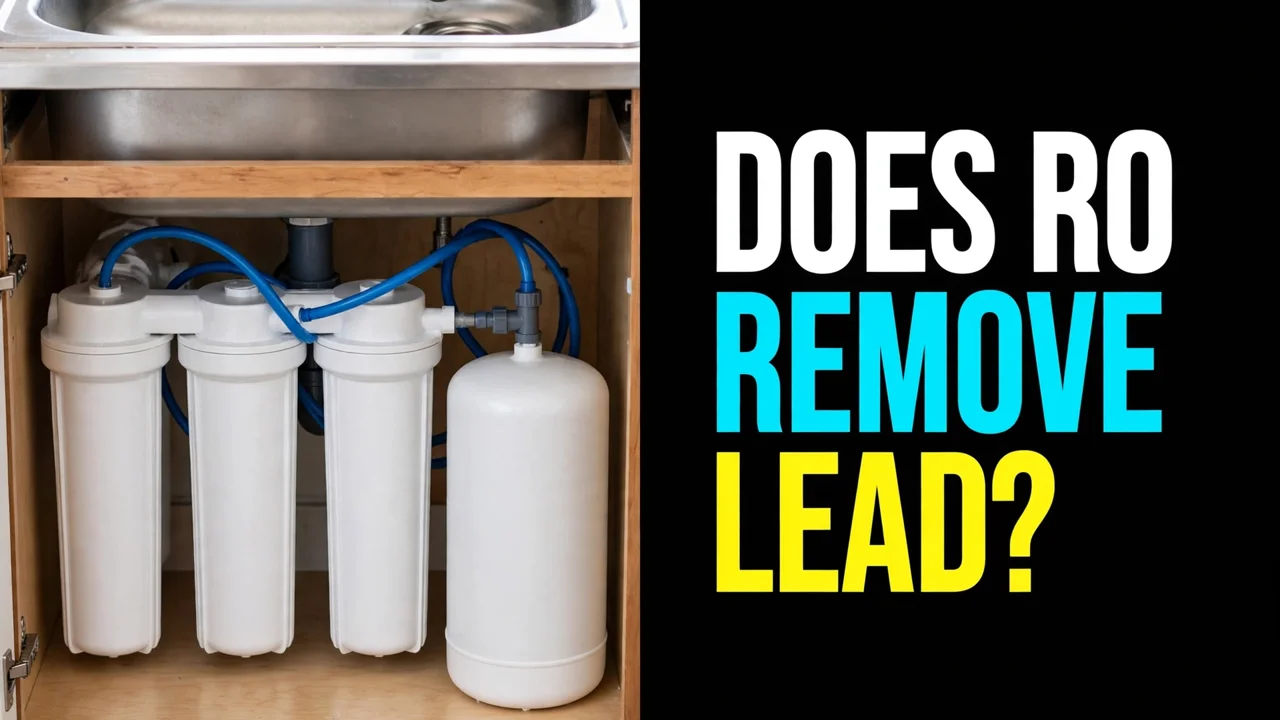

Does Reverse Osmosis Remove Lead (2026): What the Evidence Says
Guide
Lead has a nasty property that most water worries do not: it usually does not come from the treatment plant at all. It leaches out of the last stretch of pipe — an old service line, pre-1986 solder, brass fittings inside your own walls — which means the city’s clean test results can be perfectly true and your kitchen tap can still pour lead. That is exactly the situation point-of-use filtration exists for, and it is why “does reverse osmosis remove lead?” is really a question about whether the barrier under your sink is certified to do the job.
The short answer: yes — reverse osmosis removes lead, and lead reduction is one of the core health claims an RO system can be certified for under NSF/ANSI 58. Trust the listing, not the adjective: an exact model certified to NSF/ANSI 58 with a lead reduction claim has had its performance measured in a lab; a system merely described as “lead-removing” has not.
Table of Contents
Does RO remove lead?

Yes. Lead in drinking water travels as dissolved ions and fine particles, and an RO membrane rejects dissolved metals as a matter of physics: water molecules pass the membrane under pressure, lead ions do not, and the rejected stream goes to the drain. This is not a marketing discovery — lead reduction has been a certifiable claim for RO systems under NSF/ANSI 58 for decades, and public-health guidance consistently lists reverse osmosis among the effective point-of-use options for lead. The same membrane earns its keep on the neighboring questions too — the mechanism is why our RO and PFAS evidence check also lands on yes — and the third member of the family, fluoride, gets the same treatment in does RO remove fluoride.
The standard behind the claim is demanding in a specific way worth understanding. Certification testing does not sprinkle a trace of lead into clean water and celebrate a small drop; the system is challenged with water carrying lead at levels far above what a home tap produces, and the water coming out has to land at or below a strict low threshold in parts per billion. A model that passes has demonstrated margin, not luck. What certification does not cover is everything downstream of your maintenance habits — a membrane years past its service life is a different device from the one that passed the test.
Where the lead comes from
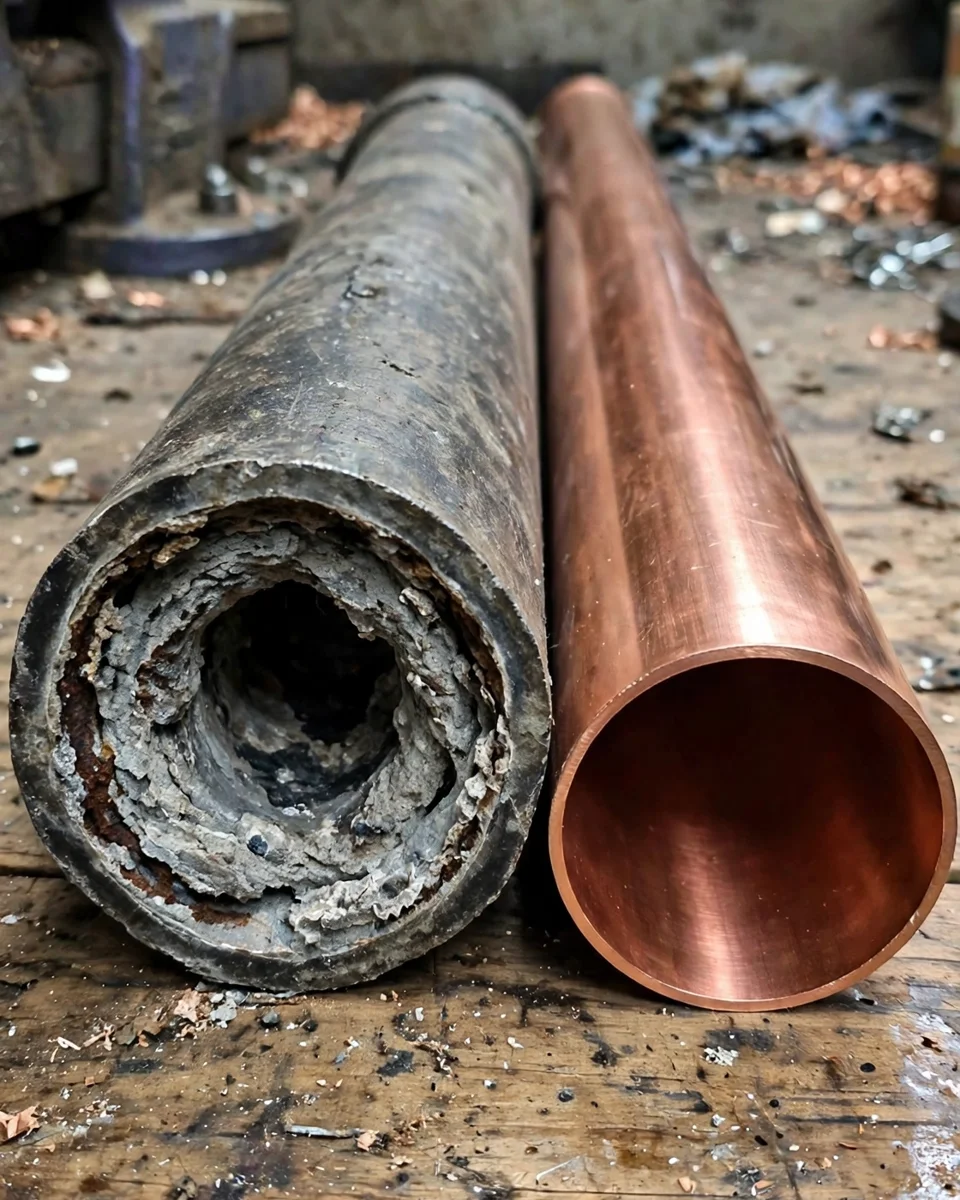
Understanding the sources explains both the risk pattern and the fix. Lead enters water by contact, and the contact points are almost all in or near your home:
| Source | Where it sits | Good to know |
|---|---|---|
| Lead service line | The pipe from the street main to the house, common in older neighborhoods | The single biggest source when present; replacement is the permanent fix, filtration is the working barrier until then |
| Lead solder | Joints in copper plumbing installed before 1986 | Releases most after water sits — first-draw water in the morning is the worst case |
| Brass fixtures and fittings | Faucets, valves, fittings (older brass could contain significant lead) | Even “lead-free” brass is a defined low-lead alloy, not zero — one more reason the last barrier sits at the tap |
| Galvanized pipe scale | Old galvanized lines that absorbed lead from upstream sources | Can release lead in bursts when disturbed, which is why levels can vary sample to sample |
Two consequences follow. First, because the source is downstream of the utility, filtration at the kitchen tap — where drinking and cooking water actually comes from — addresses the exposure directly, which is precisely RO’s placement. Second, because release spikes when water sits or plumbing is disturbed, a barrier that works every pour beats habits that only work when you remember them.
What certification actually proves
For lead, the claim to look for is specific: NSF/ANSI 58 certification with lead reduction on the claim list, for your exact model. NSF/ANSI 58 is the reverse osmosis standard, and lead is one of its defined health-effect claims — a certified model has been put through the standard’s challenge testing by an accredited certifier and appears in that certifier’s public listing. Everything else is weaker tea: “tested to NSF standards” means someone ran a test, not that a certifier stands behind the model; a percentage on the packaging (“removes up to 99% of lead!”) is a claim about a test you cannot inspect; and a system certified for taste and odor claims only (NSF/ANSI 42 territory) has said nothing certified about lead at all.
Keep the regulatory backdrop in view, because it explains why the certified-claim standard matters more than it used to. The EPA’s lead action level — the threshold that triggers utility action — has stood at 15 parts per billion, and the 2024 Lead and Copper Rule Improvements lower it to 10 ppb while pushing service-line replacement nationwide. The EPA’s health goal for lead in drinking water is zero: there is no identified safe exposure level, especially for children. Against a goal of zero, “the filter probably catches most of it” is the wrong epistemology; a certified claim with lab margin behind it is the right one.
The boiling myth

Boiling feels like purification because it genuinely is — for germs. For lead it does the opposite of helping, and this is verified guidance from both the CDC and EPA, not folklore in either direction: lead does not evaporate, does not break down with heat, and stays in the pot while water leaves as steam. Boil a pot down and the same lead is dissolved in less water — the concentration goes up. Boil-water advisories during main breaks are about microbes, and households with lead plumbing are told to filter or use bottled water for drinking and formula, not to reach for the kettle. The same logic retires the other kitchen rituals: letting water sit does nothing to a dissolved metal, and running the tap before use (flushing) lowers the first-draw spike but removes nothing — it is a dilution habit, not a barrier.
Keeping the barrier working
An RO system certified for lead is a strong barrier on day one. Staying one is a maintenance question:
Habits that keep it working
- Change pre-filters on schedule — they protect the membrane from the sediment and chlorine that age it early.
- Replace the membrane at its rated service interval, not when the water “tastes different” — lead has no taste cue at these levels.
- Draw drinking and cooking water from the RO tap (that sounds obvious, until a rushed pasta pot gets filled from the main faucet).
- Verify with a lab test if your home has a known lead service line — one first-draw sample of RO output is cheap certainty.
Habits that quietly break it
- Stretching cartridges years past their rating to save money — the certification described a maintained system.
- Trusting the fridge dispenser instead, when its cartridge carries no lead claim.
- Assuming the problem ended when a few houses on the street replaced their lines — your line, your solder, your fittings are the relevant ones.
- Skipping the question entirely because the city report looked clean — the city’s water leaves the plant clean; lead joins it on your property.
And when the day comes to replace the unit rather than the membrane, the shopping rule writes itself: start from models with the certified lead claim — our best reverse osmosis system guide is where to compare them — and treat every other feature as a bonus. (If a replacement’s remineralizing stage catches your eye, the trade-offs live in our RO water vs alkaline water comparison.)
Lead is the strongest entry on the membrane’s record, which makes its limits elsewhere worth knowing precisely — they are catalogued in what RO does not remove, from dissolved gases to the bacteria question.
Conclusion
Does reverse osmosis remove lead? Yes — reliably enough that lead reduction is a formal, lab-tested claim under NSF/ANSI 58, and public-health agencies list RO among the effective defenses. The evidence discipline is the same as everywhere in this series: the protection belongs to the certified model, maintained on schedule, not to the technology label in the abstract. With the EPA’s health goal at zero and the action level tightening from 15 to 10 ppb, a certified RO at the kitchen tap is one of the few household measures that actually meets the problem where it lives — in your own last stretch of pipe.
Update log
October 2026: Article published; action-level framing per the EPA’s 2024 Lead and Copper Rule Improvements (15 µg/L moving to 10 µg/L); boiling guidance per CDC/EPA (boiling concentrates lead). No removal-percentage claims are made for any consumer filter brand.
FAQs
Does RO remove 100% of lead?
No filter honestly promises 100% of anything, and you should distrust one that does. What a certified NSF/ANSI 58 lead claim promises is tested performance: challenged with heavily leaded water, the system brings output down to a strict low level in parts per billion. Against the EPA’s action level of 15 ppb — tightening to 10 — that tested margin is the meaningful guarantee, not an absolute zero.
Is RO or a pitcher filter better for lead?
Both technologies can carry real lead certification — pitchers and faucet filters claim it under NSF/ANSI 53, RO under NSF/ANSI 58. RO’s practical edge is capacity and placement: it treats all the water at one dedicated tap without cartridge-per-gallon costs climbing, and its certification challenge is severe. A certified pitcher is a legitimate barrier too; an uncertified anything is not.
Does boiling water remove lead?
No — it concentrates it. Lead does not evaporate or break down with heat, so as water boils away the lead stays behind in a smaller volume. The CDC and EPA are explicit on this point. Boiling is for microbial advisories; for lead, the tools are certified filtration or an alternative water source.
How do I know if my tap water has lead?
You cannot see, taste, or smell it at the levels that matter — testing is the only route. A certified lab can run a first-draw sample (water that sat in the pipes overnight) which shows your plumbing’s worst case. Many utilities offer free or subsidized lead testing, and your service line material can often be checked in the utility’s inventory or with a simple scratch test at the meter.
What is the EPA action level for lead?
The long-standing action level is 15 parts per billion — the level at which utilities must take corrective steps — and the EPA’s 2024 Lead and Copper Rule Improvements lower it to 10 ppb. Separately, the EPA’s maximum contaminant level goal for lead is zero, reflecting that no safe exposure threshold has been identified. The action level is a regulatory trigger, not a safety line.
How often must the membrane be replaced to keep lead protection?
Follow your system’s rated interval — typically somewhere in the two-to-five-year range for the membrane, with pre-filters changed far more often (commonly every 6–12 months). The certification describes a system maintained to its manual. If your home has a confirmed lead service line, a periodic lab test of the RO output is the direct way to confirm the barrier is still performing between changes.