
Does Fridge Filter Remove Chlorine (2026): What the Evidence Says
Guide
Most fridge-filter questions end in a shrug, because most contaminants are invisible, tasteless, and provable only in a laboratory. Chlorine is the glorious exception. It announces itself — the swimming-pool smell on a glass of water, the flat chemical taste in coffee — and it happens to be the one job that the certification system was built around first. So this is the rare filter question with a clean answer, and the evidence for it is unusually direct.
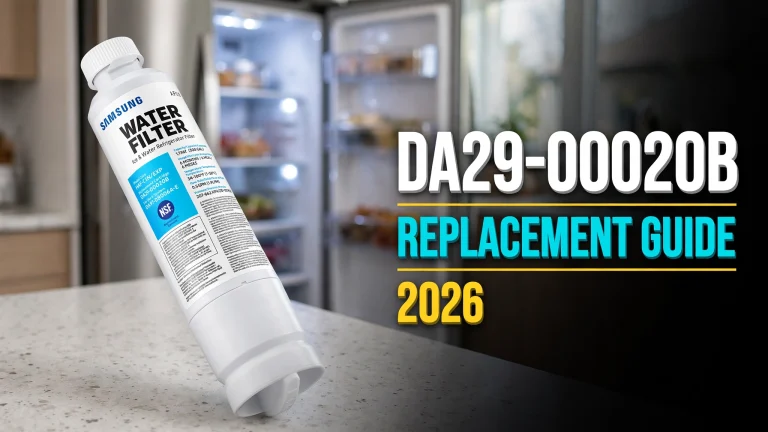
The short answer: yes — removing chlorine is the core job of every genuine refrigerator filter. Chlorine taste and odor reduction is the central claim of NSF/ANSI 42, the baseline certification that every genuine cartridge carries, including Samsung’s DA29-00020B, which holds no health claims at all but is fully certified for chlorine. The activated carbon inside reacts with free chlorine on contact and neutralizes it. The conditions that matter are a genuine cartridge, within its rated life.
Table of Contents
Quick verdict
If your water tastes like a pool and you want to know whether the cartridge in your fridge is the tool for it: yes, unambiguously — this is the claim that defines the category. You do not need an expensive model or a higher tier; the cheapest genuine cartridge on the shelf is certified for exactly this. Spend your attention instead on the two things that actually break chlorine removal in practice: cartridges that were never certified at all, and cartridges left in service long past their rated capacity, quietly exhausted while the water still runs cold and clear.
The direct answer
Model by model, the answer holds. Samsung’s DA29-00020B is certified to NSF/ANSI 42 only — no lead claim, no cyst claim, nothing from the health standards — yet chlorine taste and odor reduction is squarely in its listing, because that is what 42 is. The Frigidaire WF3CB and ULTRAWF, Whirlpool’s EDR4RXD1, LG’s LT1000P and GE’s XWFE all carry 53 and 401 on top of 42, but for chlorine specifically they are doing the same certified job as the Samsung. This is the one place in the fridge-filter world where the budget answer and the premium answer are the same answer — as the tier map in our guide to what a refrigerator filter removes shows, chlorine sits in the base tier that every genuine model shares.
One boundary is worth drawing immediately, because it causes most of the confusion in this area: chlorine is not chloramine. Some utilities disinfect with chloramine — chlorine bonded to ammonia — which is more stable, longer-lasting, and harder for standard carbon to break down. An NSF/ANSI 42 chlorine listing is a test against free chlorine; it does not by itself promise chloramine reduction, which requires specific media and its own claim. If your water’s chemical taste survives a fresh genuine cartridge, chloramine is the first suspect, and the fix is in the last section.
The certification that proves it
NSF/ANSI 42 is the aesthetic-effects standard, and chlorine reduction is its headline test: cartridges are challenged with chlorinated water at a set concentration and flow, and must reduce the chlorine to below taste-threshold levels across their rated capacity, not just on the first glass. That “across the rated capacity” clause is why the certification means something — a pinch of carbon can strip chlorine for a week; the listing verifies the cartridge keeps doing it for its rated gallons or months. When you look up a model in the NSF or IAPMO database, the 42 line with a chlorine taste-and-odor claim is the entire proof, and every genuine model has it.
Contrast that with the claims around it, because the pattern teaches the whole system. Lead needs its own claim under NSF/ANSI 53 — the 42 listing says nothing about it, which is why the DA29-00020B’s owners get chlorine removal and nothing else; our evidence checks on fridge filters and lead and fridge filters and PFAS trace those separate menus. Chlorine is simply the claim that sits at the bottom of every genuine stack. Our guide to NSF 53 certified fridge filters shows how to read the full listing when you want to check what else — if anything — your model carries.
| Cartridge type | Free chlorine (NSF/ANSI 42 claim) | Notes |
|---|---|---|
| Genuine, 42-only (e.g. Samsung DA29-00020B) | Yes — certified | Chlorine is the core of its only listing |
| Genuine, 42/53/401 (WF3CB, EDR4RXD1, LT1000P, XWFE) | Yes — certified | Same chlorine claim, plus health and emerging-contaminant claims |
| Compatible / aftermarket | Typically certified to 42 at best | Uncertified compatibles make the claim with no listing behind it |
| Any cartridge past its rated life | Not reliably | Exhausted carbon passes chlorine — returning taste is the signal |
| Chloramine (any model) | No claim under a standard 42 listing | Needs specific chloramine-rated media and its own claim |
What the science says

The mechanism is a reaction, not a sieve. Free chlorine in water exists mainly as hypochlorous acid and hypochlorite; when it meets activated carbon, the carbon’s surface reduces it to harmless chloride — the same ion already present in table salt — almost instantly on contact. That speed is why chlorine is carbon’s easiest assignment: even at a fridge dispenser's flow rate, with water spending barely a second inside the cartridge, the reaction completes. It is also why carbon is selective in a way owners find surprising: the same surface that destroys chlorine on contact has no reaction at all for fluoride, which passes through untouched — the contrast we work through in our fluoride evidence check.
The limit is capacity. Every reaction consumes surface, and the carbon bed is small, so chlorine performance is a countdown measured in gallons — the rated life printed on the listing. Two practical consequences follow. First, the returning pool taste is information: it is the classic sign the carbon is spent, even if flow and clarity look fine. Second, the first glass after the fridge sits overnight can taste stronger, because the water in the line and the ice are the oldest in the system; a short flush clears it. None of this requires a better cartridge — it requires a current one.
Why chlorine removal is reliable
- It is a certified claim on every genuine model — the headline test of NSF/ANSI 42.
- The carbon-chlorine reaction is near-instant, so even fridge flow rates cannot outrun it.
- You can verify it yourself: nose and tongue are genuine instruments for this one contaminant.
Where it breaks down
- Exhausted carbon past its rated capacity passes chlorine while water still looks perfect.
- Chloramine is a different disinfectant and is not covered by a standard chlorine claim.
- Uncertified compatibles claim chlorine removal with no listing and no capacity test behind it.
Better options if chlorine taste will not quit

Work the suspects in order. First, age: if the cartridge is past its rated months or gallons, replace it — that resolves most stubborn cases. Second, authenticity: an uncertified compatible may contain too little carbon, or carbon of poor quality, to hold the claim; a genuine cartridge is the control test. Third, chemistry: check your utility’s water quality report for chloramine. If that is your disinfectant, the in-fridge answer is limited, and the effective routes are larger carbon systems built for chloramine — catalytic-carbon under-sink or whole-house units with far more media and contact time. The fridge cartridge remains excellent at the job it is certified for; persistent taste after the first two fixes is the water telling you the job is a different one.
Conclusion
Does a fridge filter remove chlorine? Yes — it is the single most solid claim in the entire category. Chlorine taste and odor reduction is the tested core of NSF/ANSI 42, held by every genuine cartridge from the 42-only Samsung to the fully loaded GE line, and the underlying carbon chemistry is fast enough that the claim survives real-world flow. Keep the cartridge genuine and current, know the chloramine exception, and this is one filter question you never have to wonder about again.
Update log
October 2026: Article published. Certification details reflect the NSF and IAPMO listings on record for each genuine model line named; the chlorine-versus-chloramine distinction follows the scope of the NSF/ANSI 42 claim as listed.
FAQs
Does the Samsung DA29-00020B remove chlorine?
Yes. The DA29-00020B is certified to NSF/ANSI 42 only, and chlorine taste and odor reduction is the central claim of that standard. It carries no lead, cyst, or other health-contaminant claims — but for chlorine specifically, its certification is the same one every genuine cartridge holds.
Does a fridge filter remove chloramine too?
Not under a standard listing. NSF/ANSI 42 certifies reduction of free chlorine; chloramine — the chlorine-ammonia disinfectant some utilities use — is more stable and needs specifically rated media and its own claim. If your utility uses chloramine and the taste persists with a fresh genuine cartridge, a catalytic-carbon system is the effective route.
Why does my water still taste like chlorine with a new filter?
The usual causes, in order: the cartridge is a compatible without a real certification or with too little carbon; the cartridge is genuine but already past its rated life; your utility disinfects with chloramine rather than free chlorine; or you are tasting the first draw after the fridge sat idle, which a short flush fixes. Swap in a fresh genuine cartridge first — it eliminates the first two causes at once.
How long does chlorine removal last?
For the cartridge’s rated life — the gallons or months (commonly around six months) stated in its certification listing. The NSF/ANSI 42 chlorine claim is verified across that rated capacity, not just when the cartridge is new. Past it, removal fades gradually; returning chlorine taste is the practical signal to change the cartridge.
Is chlorine removal a health claim or a taste claim?
As certified, it is a taste claim. NSF/ANSI 42 is the aesthetic-effects standard — it verifies that chlorine is reduced below the level where it affects taste and odor. Chlorine is added to municipal water deliberately, as a disinfectant, and is regulated at the levels utilities use; the filter’s certified job is to make the water taste like water again, not to correct a safety failure.
Do compatible fridge filters remove chlorine as well?
The certified ones, yes — mainstream compatibles typically certify to NSF/ANSI 42 at best, and that listing does cover chlorine. The gap is with uncertified compatibles, which print the claim with no listing, no capacity test, and no audit behind it. For chlorine the practical difference is consistency: a genuine or 42-certified cartridge is verified to hold the claim for its rated life.