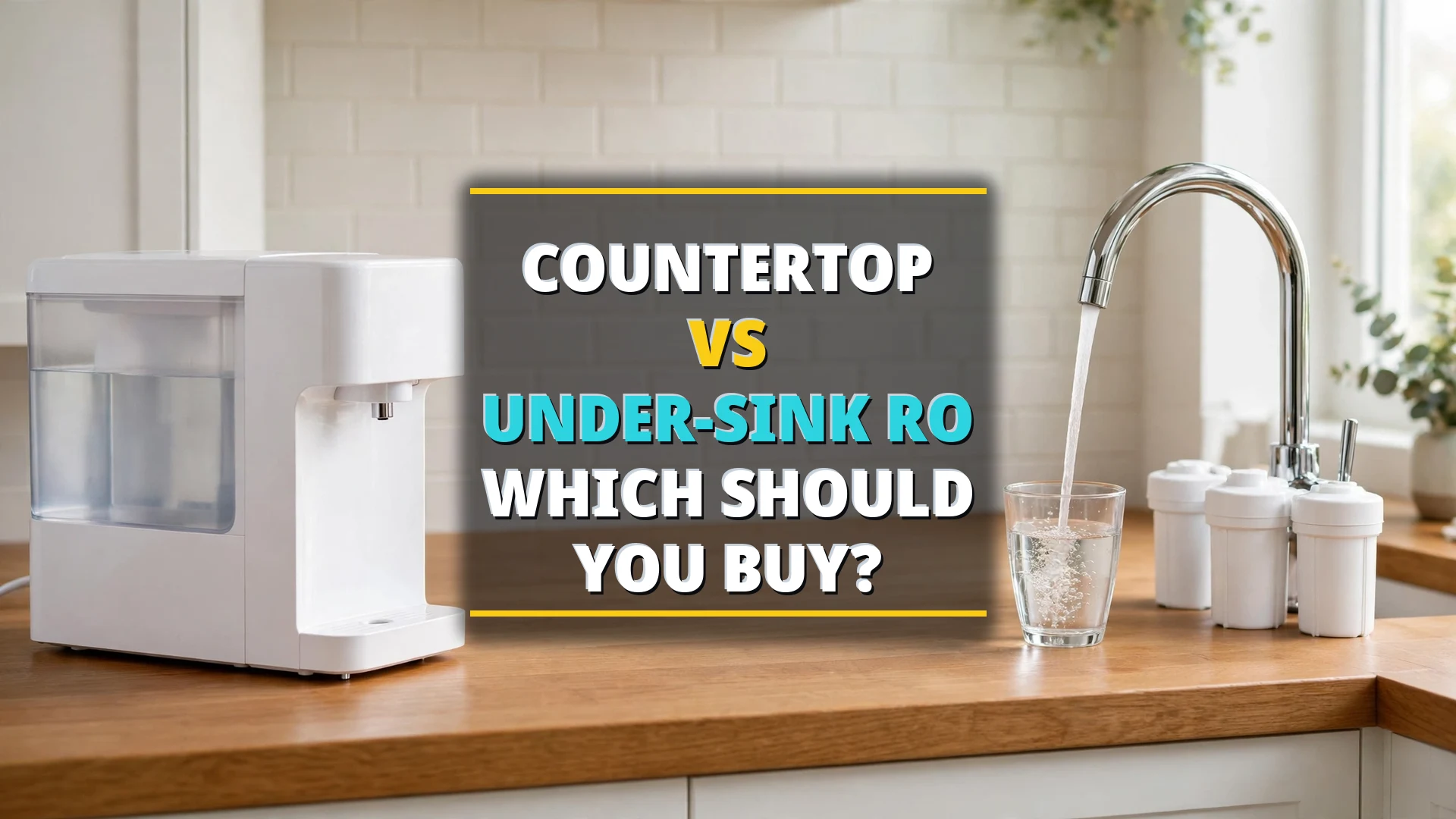

Countertop vs Under Sink Reverse Osmosis (2026): Which Should You Buy?
Your tap water tastes off — maybe a faint chlorine note, maybe you are worried about what is sitting in older pipes — and you have landed on reverse osmosis as the answer. Then comes the question nobody warns you about: do you buy the sleek box that sits on your counter and plugs into the wall, or the system that hides under your sink and asks for a drill, a faucet hole, and an afternoon?
Here is the short answer: under-sink RO is the better long-term buy for homeowners — cheaper to run year after year, bigger daily output, and it can feed your fridge’s ice maker too. Countertop RO is the better buy for renters and anyone who cannot drill a hole — zero installation, moves with you, but it costs more per gallon over time and you will babysit its water tanks. This comparison lays the two types side by side — installation, certifications, yearly costs, and what owners actually say about living with each — so you choose for your living situation, not someone else’s.
The renter-friendly format
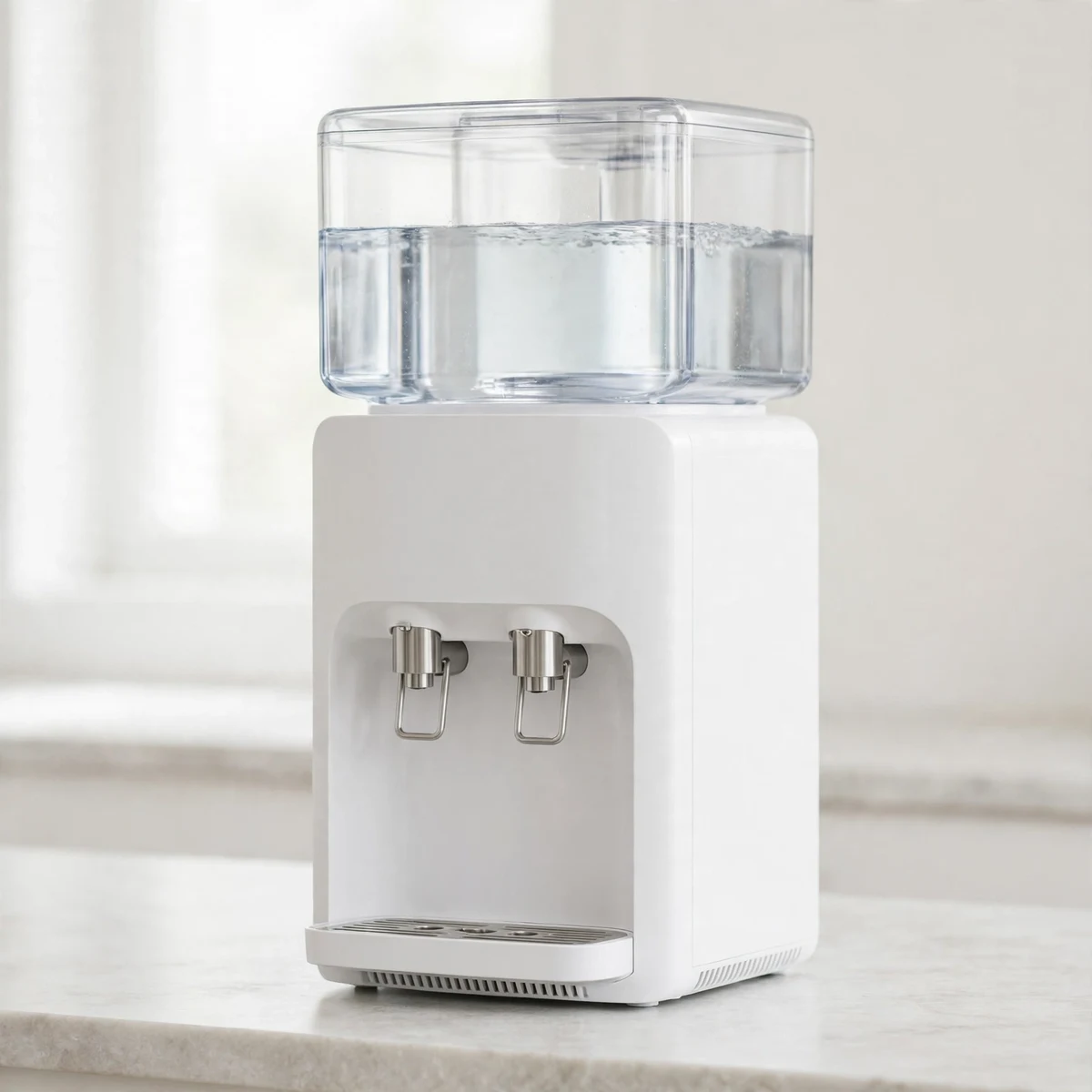
Countertop RO (Melissani M1)
~$300–400
Zero installation, moves with you, and models like the Melissani M1 pour hot and cold water in seconds.
The long-term value format
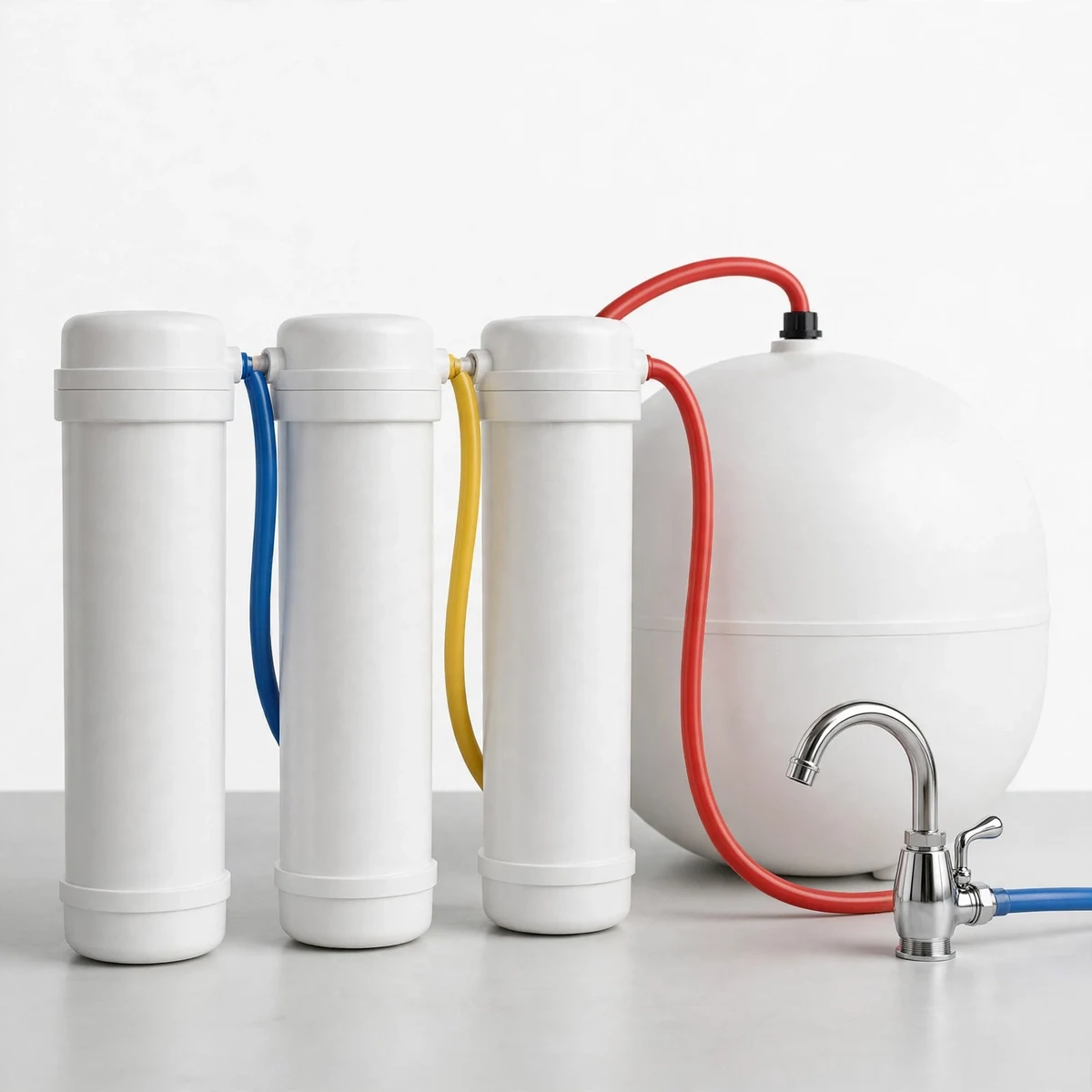
Under-sink RO (iSpring RCC7)
~$180–230
Cheaper to run year after year, bigger daily output, and it can feed your fridge’s ice maker too.
The bottom line: if you rent, buy countertop — no drilling, no landlord permission, and it moves with you. If you own your home and can handle (or hire) a simple installation, under-sink wins on nearly every long-term measure: lower yearly cost, on-demand gallons, and a fridge hookup. If you own but only need a gallon or two of drinking water a day and hate plumbing projects, countertop is still a perfectly honest choice.
Verdict: match the system to your housing situation — the “better” technology is the one you will actually install and maintain.

The decision really comes down to three questions. Can you drill? If your lease says no modifications, the debate is over before it starts. How much filtered water do you use daily? A couple of drinking glasses favors countertop; cooking, coffee, bottles, and a family favor under-sink. What bothers you more — babysitting tanks, or a one-time installation? Countertop units need their feed tank refilled and their reject tank emptied by hand. Under-sink systems need one afternoon of plumbing and then disappear under the cabinet for months at a time.
Price checked at time of writing; it changes often — see the live price before you buy.
Table of Contents
Side-by-side comparison
Same membrane technology, very different daily experience. Here is every difference that actually matters when you live with one of these:
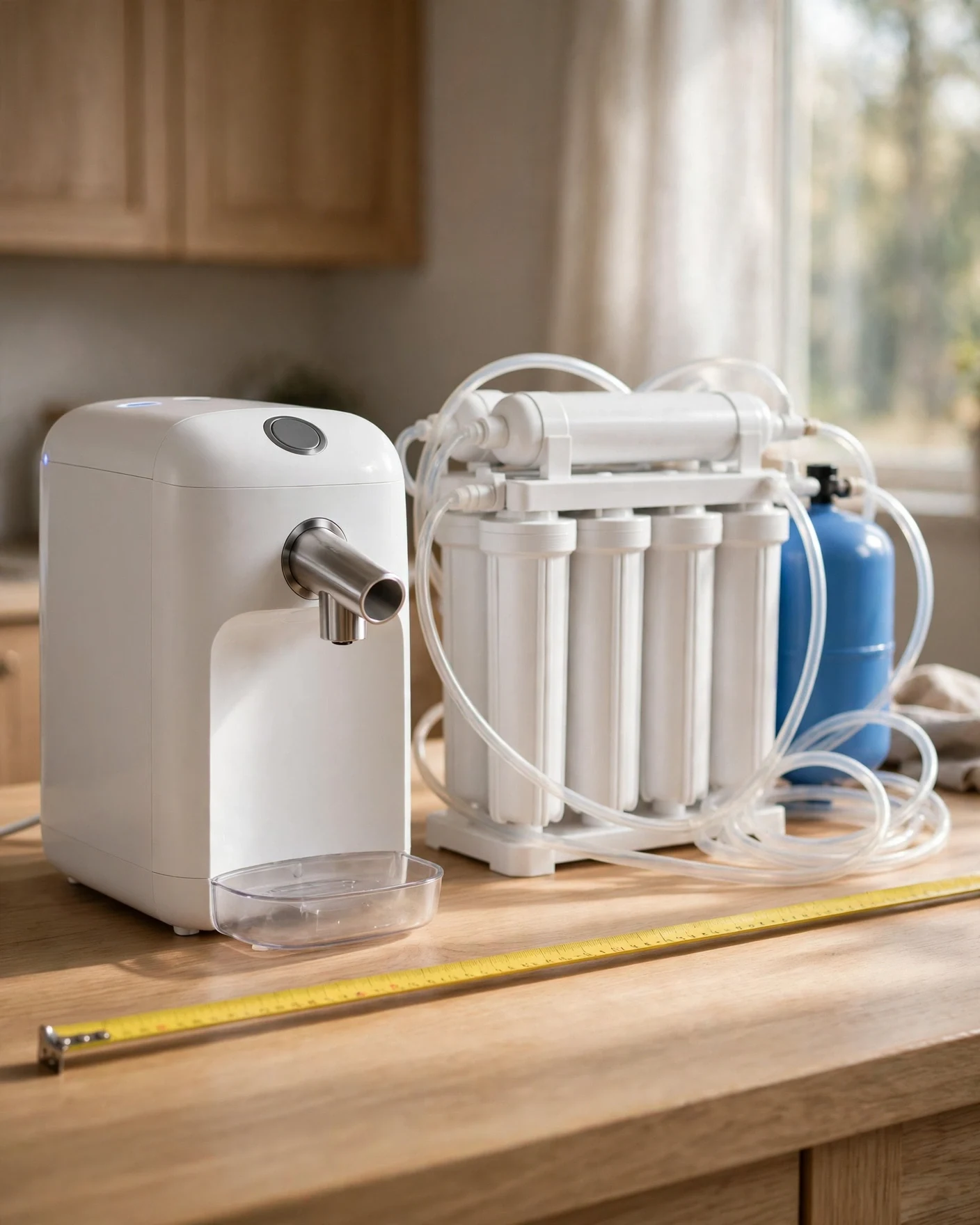
| Countertop RO | Under-sink RO ★ Winner | |
|---|---|---|
| Typical upfront price | ~$300–500 | ~$180–230 |
| Installation | None — plug into an outlet | Drill a faucet hole, connect to cold-water line and drain (~1 hour DIY, or a plumber visit) |
| Daily output | Small batches — rated GPD is a lab number and real-world output routinely runs well below it | 75 GPD class with storage tank — gallons on demand |
| Wastewater handling | Reject water collects in a tank you empty yourself — no drain line | Drains automatically through a saddle valve into the sink drain |
| Counter space | Takes ~1 sq ft of counter | None — lives under the cabinet |
| Cabinet space | None | Needs room for housings plus a storage tank |
| Fridge / ice maker hookup | No | Yes — a T-line feeds the fridge dispenser and ice maker |
| Hot & cold dispense | Some models — Melissani M1 does 3-second hot/cold; NOVETE chills to ~32°F | No — room-temperature water from its dedicated faucet |
| Certifications | Mostly unverified at research time — check listings yourself | Deeper certification history (NSF/ANSI 58 listings are common) |
| Filter changes | Every 2–6 months (varies by model) | Pre-filters every 6–12 months; membrane every 2–3 years |
| Expected lifespan | Younger category — treat 3–5+ years as the planning horizon | 10+ years is typical |
| Best for | Renters, movers, drilling-phobes | Homeowners playing the long game |
Two rows deserve emphasis. First, daily output: countertop makers print a GPD rating measured under ideal lab conditions, but owner reports and bench measurements routinely put real-world output far lower — sometimes around half the label figure — because home water pressure and temperature are rarely ideal. Treat the rating as a ceiling, not a promise. Second, hot and cold dispense is the countertop category’s surprise party trick: an under-sink faucet gives you one temperature, while units like the Melissani M1 pour hot water in seconds and the NOVETE doubles as a water chiller.
For the non-RO version of this same debate — simple carbon filters rather than membranes — see our under-sink vs countertop water filtration comparison.
Price checked at time of writing; it changes often — see the live price before you buy.
Certifications: where the proof is (and isn’t)
Both types use reverse-osmosis membranes, and the honest question is not “which filters better” but “which one’s claims can I verify.” That is where the two types split hard.
NSF/ANSI 58 is the standard written specifically for reverse-osmosis systems, and it is the certification that matters most in this comparison. (NSF/ANSI 42 covers taste and odor; 53 covers health-related contaminants — both apply to the pre- and post-filters around the membrane.) Under-sink RO has decades of third-party certification history behind it. The iSpring RCC7 — the classic 5-stage, 75 GPD under-sink unit — is widely reported with an NSF/ANSI 58 listing, and we recommend looking up the current listing yourself in the public database at info.nsf.org before you buy, since listings can change.
Countertop RO is where claims get slippery. The NOVETE and the Melissani M1 — the two countertop models referenced in this comparison — had no verifiable NSF/ANSI 58 listings we could find in the public database at research time. That does not prove they filter poorly; it proves you cannot confirm their reduction claims from an independent certifier, so treat any contaminant-reduction marketing as unverified until you see a database listing.
Two traps to know. First: “tested to NSF standards” is not “certified.” Anyone can test against a standard; certification means an accredited lab verified it and keeps checking. Second: a badge on the box may certify the plastic, not the water. NSF/ANSI 372, for example, certifies lead-free materials — it says nothing about contaminant reduction. Some countertop listings carry 42/401/372-style badges that look impressive and mean far less than they appear to. Independent tester waterfilterguru has reported that, of the countertop systems they checked, only AquaTru held a full performance certification (IAPMO to NSF 42, 53, 58, and 401) — which tells you how thin the paper trail is across the rest of the category.
Certification covers only the contaminants in the database entry, and only under the certifier’s test conditions. A certified unit with a neglected, years-old membrane is just an expensive faucet — the certificate does not do the maintenance for you.
What a year of ownership really costs
The sticker price is the least important number on this page. Under-sink systems look cheaper upfront and stay cheaper: fewer filter changes, longer membrane life, and a mature replacement market that keeps cartridge prices down.
| Under-sink (typical) | Countertop (typical) | |
|---|---|---|
| Upfront system price | ~$180–230 | ~$300–500 |
| Prefilter / cartridge changes | Every 6–12 months (~$25–40 per set) | Every 2–6 months (varies by model) |
| RO membrane replacement | Every 2–3 years (~$40–70) | Every 1–2 years (~$50–100) |
| Estimated yearly filter cost | ~$75 | ~$80–130 |
| Estimated 3-year total | ~$400–460 | ~$540–890 |
| Expected system lifespan | 10+ years is typical | Younger category; treat 3–5+ years as the planning horizon |
Two things jump out. First, the countertop premium is not really the upfront price — it is the cartridge treadmill: more frequent changes at higher per-cartridge prices. Second, the under-sink advantage compounds: on a 10-year horizon, the gap is not hundreds of dollars, it is potentially over a thousand. That is the financial case for drilling the hole — if you are allowed to drill it.
The counterpoint: a renter who uses one ~$400 countertop unit across three apartments still spends less than one who installs under-sink and abandons it at move-out. Cost math only works inside your actual living situation. If you are still deciding whether you even need RO at all, our countertop water filter vs reverse osmosis comparison explains when a simple filter is enough — and we compare specific countertop RO models in our best countertop reverse osmosis system roundup.
Owner voices: what living with each is like
Spec sheets tell you what a system does. Owners tell you what it is like to live with. We read through owner feedback on both types and kept the complaints and praise that repeat across many owners over many months — not one-off bad experiences.

What countertop owners love
It works the day it arrives. Unbox, fill the tank, plug in — filtered water in minutes. Renters consistently call this the whole point. Hot and cold on demand is the surprise delight: owners of hot/cold models report the instant-hot spout replacing their kettle and the chilled spout replacing fridge pitchers. And it moves with you — the unit goes in the moving box like any other appliance.
What countertop owners complain about
The tank shuffle. The number-one recurring complaint: refilling the feed tank and emptying the reject tank gets old, especially in households that cook with filtered water. Small batches follow — fill a stockpot and you are waiting through another slow cycle. Counter space is the third: a footprint the size of a coffee maker that you cannot put away. And several owners note that replacement cartridges cost more per change than the under-sink sets their friends buy.
What under-sink owners love
Endless on-demand water. The dedicated faucet is always ready — fill pots, bottles, and the coffee maker without a second thought. The fridge hookup gets mentioned constantly: ice cubes and the fridge dispenser running on RO water feels like a luxury upgrade. And cheap, infrequent filter changes — owners report going a year or more between pre-filter swaps, with cartridges that cost less than countertop equivalents.
What under-sink owners complain about
Installation day. Drilling a faucet hole through granite or quartz scares people, and renters with strict leases cannot do it at all. Lost cabinet space — the housings plus the storage tank eat a real chunk of under-sink storage. Slow tank recovery on high-demand mornings: drain the tank with a big cooking session and the next glass takes a while. And owners of older-style units grumble about drain-line waste — modern tankless designs waste far less (around 0.5–2:1 versus 3–4:1 on old tank systems), but the drain connection still sends water away every cycle.
One recurring debate deserves an honest answer: does RO water taste flat or “empty”? The owner consensus is that this is a taste question, not a health one — food dwarfs water as a mineral source in any normal diet. Some people love the clean taste; some add a remineralization stage for a rounder flavor. Either way, it is preference, not safety.
Still weighing the two lifestyles against your own situation? Our guide to whether you should get a countertop or under-sink water filter walks through the decision step by step.
Which should you buy?

Renters and frequent movers: buy countertop. The Melissani M1’s 3-second hot/cold dispense is genuinely useful day to day, and the NOVETE’s chilling function replaces a fridge pitcher if cold water matters to you. You give up per-gallon economy and on-demand volume; you gain zero installation and total portability. That is a trade worth making.
Homeowners: buy under-sink. The iSpring RCC7 class — 5 stages, 75 GPD, storage tank — costs less upfront, roughly half as much to run over three years, lasts a decade, and feeds your fridge. The one-time installation is the entire price of admission, and it pays for itself.
Homeowners who hate DIY: you have two honest options — pay a plumber for an hour’s work and join the under-sink camp, or buy countertop and accept the tank shuffle. There is no wrong answer here, only a wrong reason: do not buy under-sink and then never install it, and do not buy countertop expecting under-sink output.
For a closer look at specific models rather than system types, see our head-to-head of countertop RO vs under-sink RO models.
Price checked at time of writing; it changes often — see the live price before you buy.
FAQs
Does countertop RO water taste the same as under-sink RO water?
Yes, when both are properly maintained — they use the same membrane technology, so the differences are capacity and convenience, not purity. Taste mostly comes down to fresh filters and how much dissolved solid the membrane removes. Some people find RO water tastes “flat” either way; that is personal preference, and a remineralization stage can round the flavor out if it bothers you.
How much water does a countertop RO system waste?
Most countertop models collect reject water in a tank you empty yourself — no drain line needed. Waste ratios vary by design: older-style systems ran around 3–4 gallons of waste per gallon of purified water, while modern designs do much better, around 0.5–2:1. At 1–2 gallons a day of drinking water the absolute waste is small, and you can reuse the reject-tank water for houseplants.
Can I hook an under-sink RO up to my fridge’s ice maker?
Yes — this is one of the under-sink type’s biggest perks. A T-valve line feeds RO water to the fridge, so the ice maker and the fridge dispenser both run on filtered water. Countertop units cannot do this; they are standalone appliances with no plumbing connection.
Do countertop RO systems need a drain or a water line?
No — that is the whole point of the category. You fill the feed tank by hand and empty the reject tank yourself. The tradeoff is small batches: you get a tank’s worth of water at a time, then wait for the next cycle.
How often do I change filters on each type?
Under-sink systems: pre-filters roughly every 6–12 months and the RO membrane every 2–3 years. Countertop units: every 2–6 months depending on the model and how much water you run through it. These are estimates — always go by your specific model’s rated filter life and your water quality.
Is NSF/ANSI 58 certification important when buying RO?
It is the most meaningful certification in this category — NSF/ANSI 58 is the standard written specifically for reverse-osmosis systems. A listing you can look up yourself at info.nsf.org is the strongest proof a system does what it claims. Many countertop models lack a verifiable listing, so check the database before you buy rather than trusting the box.
Which type is better for a renter?
Countertop, almost always. No drilling, no landlord permission, and the unit moves with you to the next apartment. Under-sink only makes sense for a renter with written permission from the landlord and a plan to restore the sink — plug the faucet hole and remove the drain connection — at move-out.
Conclusion
Countertop and under-sink RO are two routes to the same glass of water. Under-sink is the long-game system: cheaper to buy, cheaper to run, bigger output, fridge hookup — and it asks for one afternoon of installation in return. Countertop is the freedom system: zero installation, hot and cold on demand, moves with you — and it asks you to babysit tanks and pay more per gallon in return. Pick the one that fits your lease, your kitchen, and your patience — and whichever you choose, change the filters on schedule, because the certificate on the box does not do the maintenance for you.
Price checked at time of writing; it changes often — see the live price before you buy.
Update log
- Zulqarnain: Review published.