
ZeroWater 12 Cup Pitcher Review (2026): Is It Worth It?
★ 12-CUP PITCHER REVIEWYour tap water spots every glass, crusts up the kettle, and tastes faintly of dissolved chalk. A basic taste filter barely dents that, because it was built to fix chlorine flavor, not to strip out minerals. So now you are looking at the ZeroWater 12-Cup pitcher — the one that promises water at zero dissolved solids, with a meter in the box to prove it.
Here is the short answer: the 5-stage ion-exchange filter really does pull total dissolved solids down to near zero, and it carries independent certification for lead, mercury, chromium VI, PFOA/PFOS, and chlorine. But it is also the slowest-filtering pitcher in its class, and its filters burn out fast — running one can cost several times more per year than running a Brita. This review separates the certified claims from the marketing and runs the real filter-cost math.
Our scores
Table of Contents
Bottom line
The bottom line: the ZeroWater 12-Cup is the deepest-filtering pour-through pitcher you can buy — certified reductions for lead, mercury, chromium VI, and PFOA/PFOS, and water at or near zero total dissolved solids. The catch is cost and patience: filters rated around 15–25 gallons and slow filtration make it the most expensive pitcher to run in its class.
Verdict: worth it if zero-TDS water or certified lead and PFAS-compound reduction is your actual goal; not worth it if you just want better-tasting water at a sane yearly cost.
Price checked at time of writing; it changes often — see the live price before you buy.
How we researched
- Compared the ZeroWater 12-Cup against the Brita pitcher family and PUR’s pitcher line — on published specs, capacity, certified claims, and filter economics.
- Checked certification claims against ZeroWater’s own Performance Data Sheet and the IAPMO certification listing for the 5-stage filter (as compiled by MyTapScore). A contaminant not in the certified list is never presented as certified here — re-check any listing yourself at info.nsf.org or in the IAPMO directory.
- Read owner reviews across major retail listings — looking for recurring complaint themes (the same problems repeated by many owners over many months), not one-off bad experiences.
- Ran yearly filter-cost math — from October 2026 street prices for official 4-pack replacement filters and brand-rated filter life, cross-checked against TechGearLab’s published cost estimate.
Pros and cons
Pros
- Deepest pour-through filtration you can buy — the 5-stage ion-exchange filter brings TDS to near zero, and owners praise the clean, neutral taste.
- Real certification behind the headline claims — IAPMO-certified to NSF/ANSI 53 for lead, mercury, chromium VI, and PFOA/PFOS, plus chlorine under NSF/ANSI 42.
- TDS meter included in the box — you can see when the filter is spent (the brand’s rule: change at a reading of 006) instead of guessing by calendar.
- Large 12-cup capacity — fewer refills than most pitchers, and the Ready-Pour design lets you dispense while the reservoir is still filtering.
Cons
- Highest running cost in the pitcher class — filters are rated around 15–25 gallons, and heavy or hard-water households can burn through several a month.
- Slow to filter — five stages take their time; independent reviewers scored its flow the weakest in its class.
- Heavy and space-hungry — a full 12-cup pitcher is a serious lift, and its 10.1-inch height needs a clear refrigerator shelf.
- Taste swings at end of filter life — spent resin is a known source of sour or fishy off-tastes right before the meter says change.
Certifications (database-checked)
The certified list is short, and that is a good sign — it means the claims below are the ones an independent certifier actually signed off on. The 5-stage filter is certified by IAPMO (the certifying body behind the listing) to NSF/ANSI standards 42 and 53. Every row in this table traces to ZeroWater’s published Performance Data Sheet and the IAPMO listing for the filter, as compiled by MyTapScore:

| Contaminant | Certification | Source |
|---|---|---|
| Lead | NSF/ANSI 53 (IAPMO-certified) | Performance Data Sheet |
| Mercury | NSF/ANSI 53 (IAPMO-certified) | Performance Data Sheet |
| Chromium VI (hexavalent) | NSF/ANSI 53 (IAPMO-certified) | Performance Data Sheet |
| PFOA / PFOS | NSF/ANSI 53 (IAPMO-certified) | Performance Data Sheet |
| Chlorine taste and odor | NSF/ANSI 42 (IAPMO-certified) | Performance Data Sheet |
Two honest limits. First, ZeroWater also publishes independent lab results covering 24 contaminants — that is evaluation data, not certification; only the rows above carry certification. Second, fluoride is not on the certified list. And “zero TDS” is not a certification either: TDS is a measurement, not a safety verdict.
Certification covers only the contaminants in the listing, and only under the standard’s test conditions. If certified lead reduction is your main goal but you would rather change filters twice a year, our Brita Elite review covers the other end of that trade-off.
Design and usability
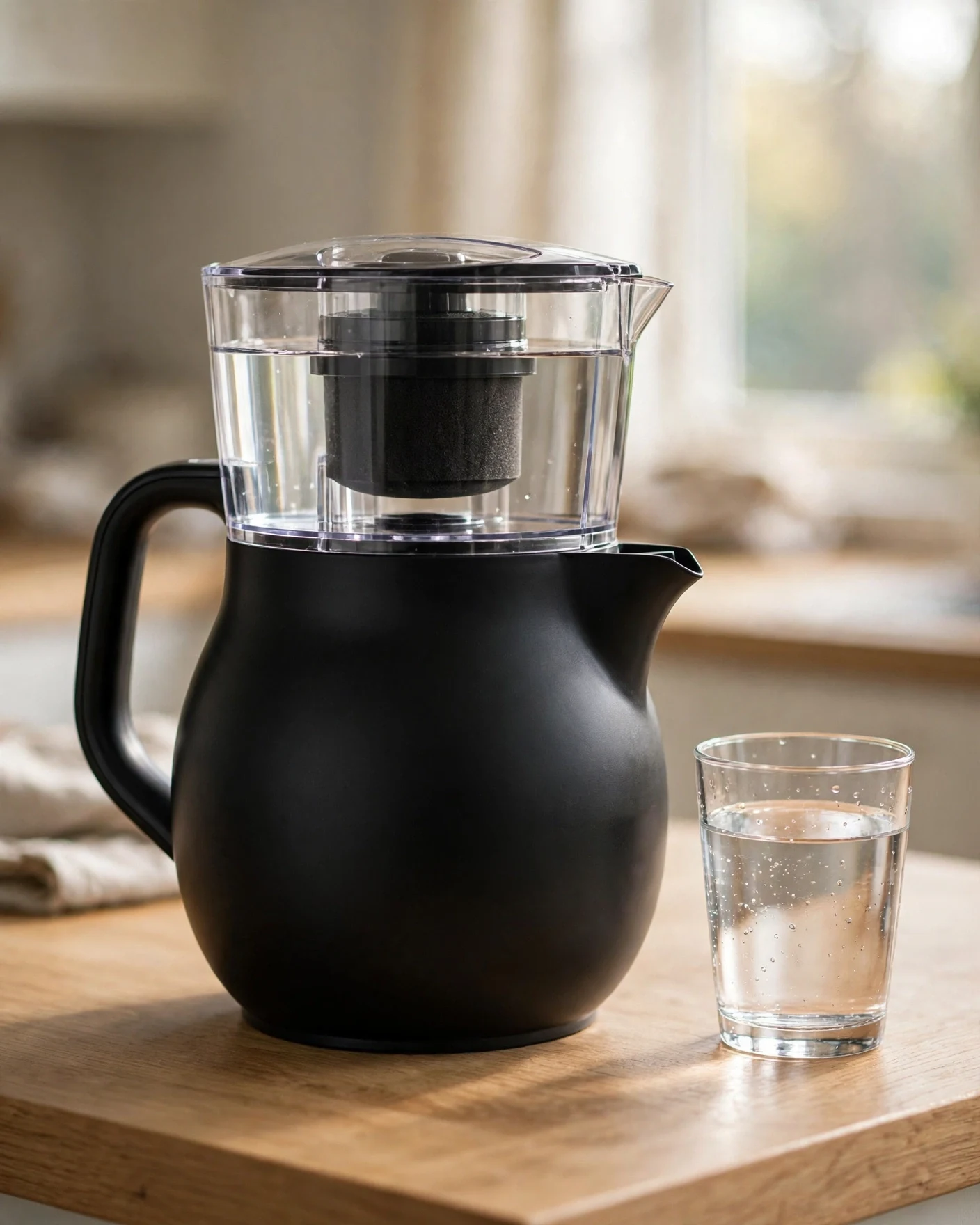
The 12-Cup is a reservoir pitcher with a twist: you fill the top reservoir, water works down through the 5-stage cartridge screwed into its base, and filtered water collects in the 12-cup (96 fl oz) body below. The Ready-Pour spout lets you dispense while the reservoir is still filtering. Two versions circulate: the classic Ready-Pour with a separate handheld TDS meter, and the Ready-Read (model ZP-012-RR), which builds the readout into the pitcher. The filter is the same either way.
Using the meter becomes a habit fast: dip it in a glass of filtered water and read the number. Fresh filter, it reads 000. As the resin loads up with dissolved solids, the number creeps — and at 006 the brand says change the filter. That habit is the difference between owners who love this pitcher and owners who think it stopped working.

Size is the other daily reality. At 5 × 10 × 10.1 inches, the pitcher needs a real refrigerator shelf, and full it carries roughly six pounds of water alone. If that footprint is too much fridge for a taste-only job, the Brita Everyday pitcher review covers the smaller everyday option, and the Brita Stream review covers the filter-as-you-pour design for people who hate waiting on reservoirs either way.
Filter cost math
With most pitchers, the filter bill is a footnote. With ZeroWater, it is the review. The cartridge does more work per gallon than a carbon filter — stripping dissolved solids is what wears it out — so the honest way to judge this pitcher is cost per year at your usage:
| Your daily use | Filters per year (at ~15–25 gal each) | Estimated yearly filter cost |
|---|---|---|
| Light — 0.5 gallon/day | ~7–12 | ~$85–180 |
| Typical — 1 gallon/day | ~15–24 | ~$180–360 |
| Heavy — 2 gallons/day | ~29–49 | ~$350–735 |
The inputs: official replacement filters run about $12–15 each in 4-packs (roughly $46–62 per pack at October 2026 street prices — estimates), and the brand’s estimated filter life is 15 gallons, with reviewers landing nearer 25 in softer water. TechGearLab puts ZeroWater running costs at $240–960 per year at 40–160 gallons a month — a third-party estimate, not our measurement, but it points the same way. For contrast, a standard Brita cartridge is rated at 40 gallons and costs less: the ZeroWater premium is a per-gallon premium, paid every month you own it.
What owners complain about
Filters die fast in hard water. This is the dominant theme across owner reviews, and it is physics, not defects: ion-exchange resin exhausts in proportion to the dissolved solids it strips out. In high-TDS areas (200+ ppm), owners commonly report filter life at the short end of the 15–25 gallon range — sometimes two to four weeks of family use. There is no fix; there is only the math in the section above.
Slow filtering. Five stages, including a resin bed, cannot rush. Independent reviewers scored this pitcher’s flow the weakest in its class, and ZeroWater’s own manual lists slow filtration as the first sign of a spent or clogged filter — the slowness is structural.
Off-tastes: plastic at first, sour or fishy later. A new pitcher can carry a faint plastic note until it is washed and the first reservoir or two are run through. The bigger theme is end-of-life taste: as the resin exhausts, owners report sour, lemony, or fishy flavors, which reviewers link to compounds released as the resin breaks down.
Meter confusion. The meter causes its own complaints: readings taken in the pitcher instead of a clean glass, confusion between the handheld meter and the Ready-Read built-in version, and owners expecting 000 forever. Rinse the glass, dip, read — and change the filter at 006.
Lid, pour, and weight niggles. Retail listing summaries repeat the same smaller themes: lids that are stiff to remove, occasional drips and spills when pouring a full pitcher, and a full 12-cup body that is simply heavy. Annoying, not disqualifying — but real.
None of these are hidden gotchas — they are the ownership reality of the deepest-filtering pitcher in the class. The filter-life one is the budget line that decides whether you still love it in month six.
Who should buy it
Buy it if
- You want the deepest pour-through filtration available — near-zero TDS water without installing anything.
- Lead or PFAS compounds are your specific worry and you want certified reductions (lead, PFOA, PFOS) behind the claim, not marketing.
- You like measurable feedback — the included meter turns filter changes from guesswork into a number.
- Your tap water is soft to average in TDS — lower mineral loads stretch each filter toward the top of its life range.
Skip it if
- You only want better-tasting water — a basic Brita does that job at a fraction of the yearly cost.
- You hate filter chores — this pitcher can want a fresh cartridge every few weeks in hard-water homes.
- Your water is very hard or high-TDS — the running-cost math turns brutal fast.
ZeroWater loyalist on a smaller budget? Our ZeroWater 10-Cup Ready-Pour review covers the smaller sibling, which runs the same 5-stage filters in a cheaper body. And if you need family-size capacity without the ZeroWater filter bills, the Brita Grand review is the cheaper big-pitcher route.
The specs
- Brand
- ZeroWater (Culligan)
- Model
- 12-Cup (ZP-012-RR Ready-Read)
- Capacity
- 12 cups (96 fl oz)
- Dimensions
- 5″ × 10″ × 10.1″
- Filter
- 5-stage ion exchange
- Filter rated life
- ~15–25 gallons (brand estimate)
- Certifications
- IAPMO to NSF/ANSI 42 & 53
- TDS meter
- Included
- Typical pitcher price
- ~$35–45 (estimate)
- Material
- BPA-free plastic
FAQs
How long does a ZeroWater filter really last?
The brand rates each 5-stage filter at an estimated 15 gallons, and reviewers measuring real-world life in softer water land around 25 gallons. The honest answer is that your tap decides: the filter spends itself stripping dissolved solids, so high-TDS water burns it out faster. The rule that matters is the meter — when filtered water reads 006, the filter is done, whatever the calendar says.
Does a 000 TDS reading mean the water is perfectly safe?
No. TDS measures dissolved solids only — minerals, salts, and metals — and says nothing about bacteria, viruses, or every chemical. ZeroWater’s own manual warns that the meter “should not be used to assess the safety or purity of water.” Treat a 000 reading as proof the ion-exchange stage is working, not as a lab report on your water.
Does the ZeroWater 12-Cup pitcher remove lead?
Yes — the 5-stage filter is IAPMO-certified to NSF/ANSI 53 for lead reduction. ZeroWater’s Performance Data Sheet records 99.7% reduction at pH 6.5 and 95.9% at pH 8.5 under certification test conditions. Certification covers those listed conditions; if lead is your main concern, testing your own water first tells you your starting level.
Does ZeroWater remove PFAS?
The certified claim covers two specific compounds — PFOA and PFOS — under NSF/ANSI 53, and that is genuinely more than most pitchers offer. But broader claims you may see about “total PFAS” or the whole forever-chemical family are not what the certification says. Judge this pitcher on the two certified compounds, not the marketing umbrella.
Does ZeroWater remove fluoride?
Fluoride is not on the certified list for this filter. In one third-party lab evaluation (WaterFilterGuru’s home water test), fluoride fell to undetectable levels in that sample — but that is a single test result, not a certification, and results vary with your water. If fluoride reduction is your goal, buy on certified claims, not this one.
Why does my ZeroWater water taste sour or fishy?
That taste is the classic sign of an exhausted ion-exchange resin. As the resin breaks down near the end of its life it can release compounds that reviewers and owners describe as sour, lemony, or fishy. Check the meter: if your filtered water reads above 000 — and especially at 006 — the filter is finished, and no amount of rinsing brings it back.
Is the ZeroWater 12-Cup worth it over a Brita?
They do different jobs. A Brita is a cheaper taste filter with much longer filter life; the ZeroWater strips dissolved solids to near zero and carries certified lead and PFOA/PFOS reduction, but costs far more per gallon and filters slowly. Buy the ZeroWater for what it removes; buy the Brita for what it costs.
Conclusion
The ZeroWater 12-Cup is a specialist: the strongest filtration you can get from a pour-through pitcher, with certified reductions backing the headline claims — and the highest running costs and slowest flow in its class. If zero-TDS water or certified lead and PFAS-compound reduction is the point, it earns its counter space. If you wanted better-tasting water on a budget, it was never the right buy. Know which problem you have, and the decision makes itself.
Price checked at time of writing; it changes often — see the live price before you buy.
Update log
- Zulqarnain: Review published.