
Refrigerator Water Filter Replacement (2026): The Full Walkthrough
Guide
Every six months the same small ritual comes due, and every six months it raises the same questions. Where is the filter in this fridge? Which cartridge number is the right one? Why does the light stay red after the swap? And is the genuine cartridge worth two or three times the compatible? This walkthrough answers all of it in order — signs, location, the swap itself, flushing, resetting — for any brand.
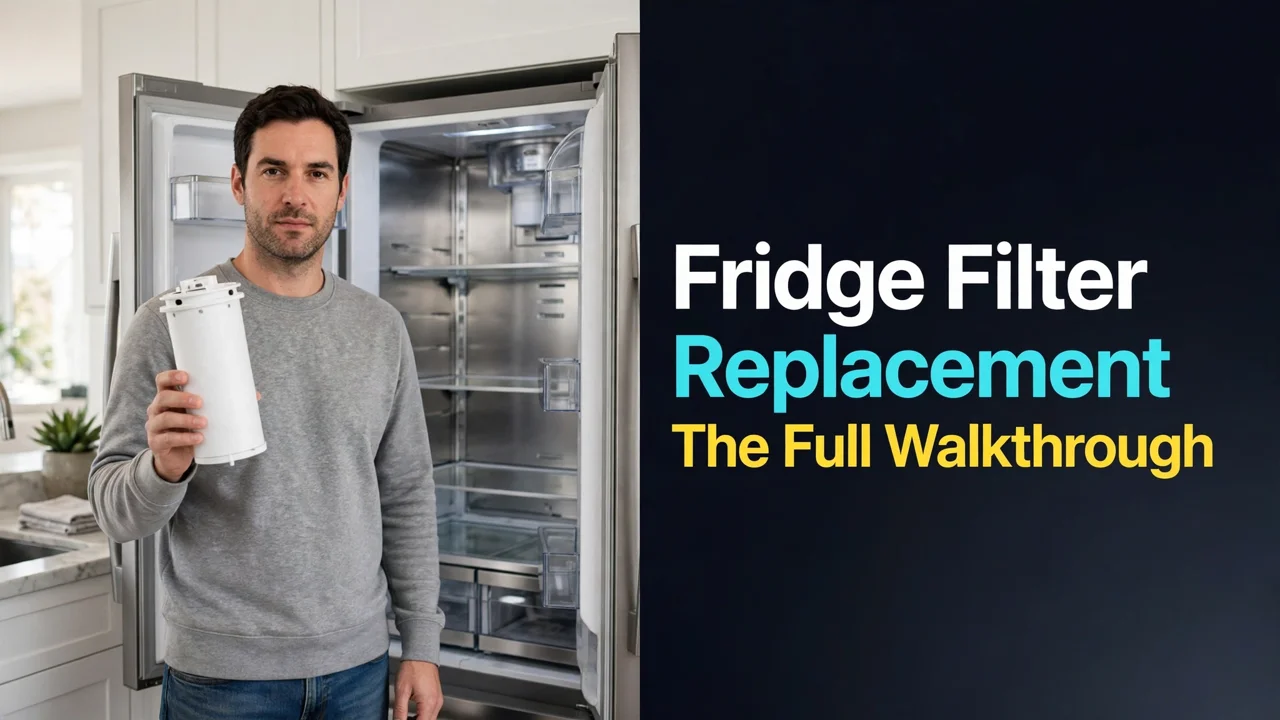
The short version: a refrigerator water filter replacement takes under 10 minutes and no tools. Find the cartridge (upper corner, door, between the crispers, or the base grille), match its part number, twist or push the old one out, seat the new one, flush 2–4 gallons, hold the reset button. The details that actually matter are the part number and the flush — get those right and the rest is choreography.
Table of Contents
The signs it is time

The filter light is the obvious one, but treat it for what it is: a six-month timer, not a sensor. The physical signs are more truthful. Flow drops — the dispenser stream thins, a glass takes twice as long, ice cubes come out small or hollow because the ice maker is being starved. Taste drifts — chlorine pushes through first, then a general staleness. The ice changes — cloudy cubes or off flavors in drinks. Any one of these before the light says your water (sediment-heavy or high-use) is exhausting cartridges early; all of them after the light says you are simply overdue. A cartridge left long past its life does not just stop helping — an exhausted carbon bed can shed fines and, in neglected cases, harbor growth. Six months is the ceiling, not a suggestion.
Find your filter (and its part number)
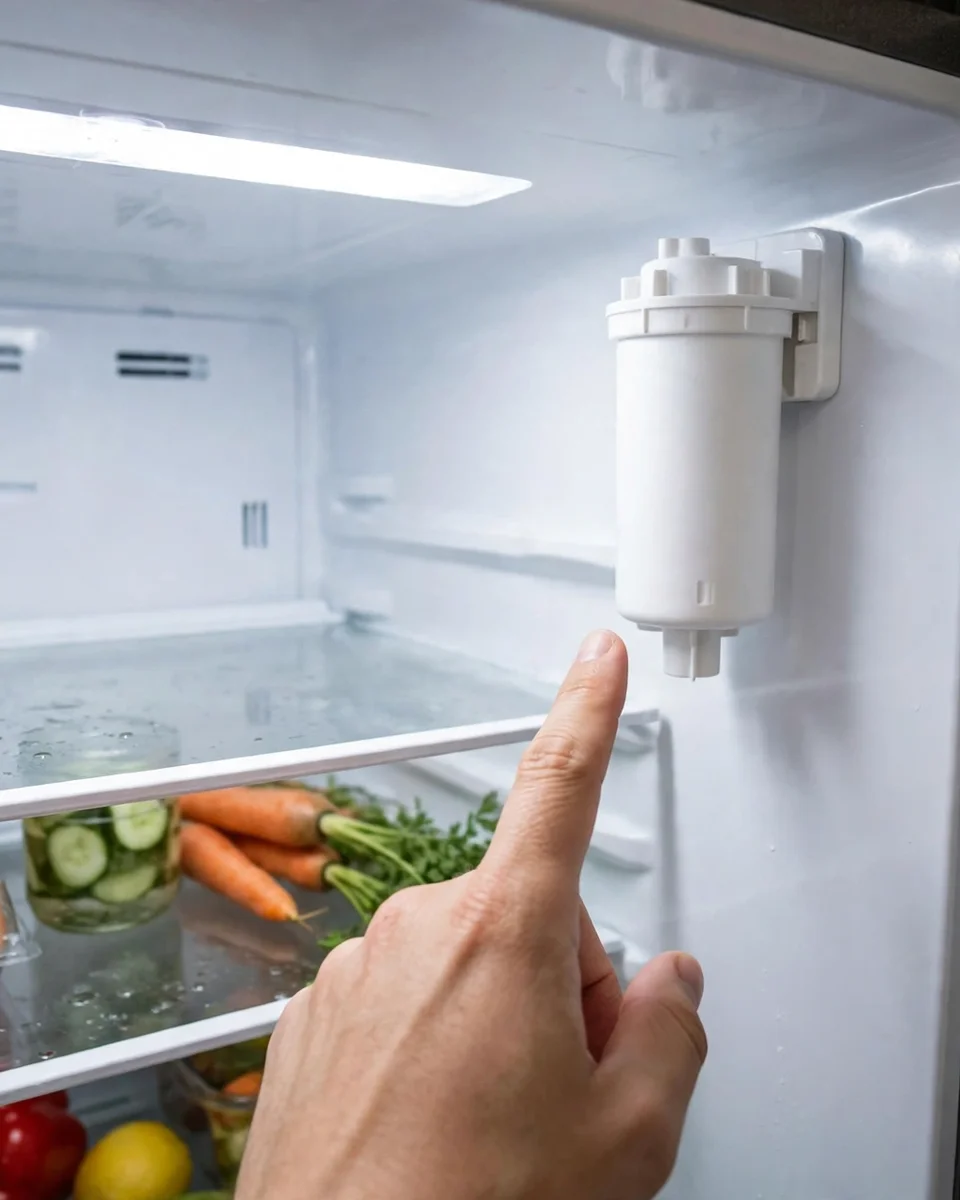
Nearly every fridge hides its filter in one of five places:
| Location | Typical brands | Examples |
|---|---|---|
| Upper corner inside (ceiling or side wall) | LG, older Samsung, Whirlpool interiors | LT1000P ceiling mount, EDR4RXD1 drop-down housing |
| Between the crisper drawers | Samsung French-door | HAF-QIN / DA29-00020B |
| Top of the fresh-food door | GE Profile / Café | XWFE door compartment |
| Base grille (bottom front) | Older Whirlpool, KitchenAid, some GE | Push-button or quarter-turn grille cartridges |
| External, on the water line behind the fridge | Any brand (inline) | Inline cartridges with push-fit ends |
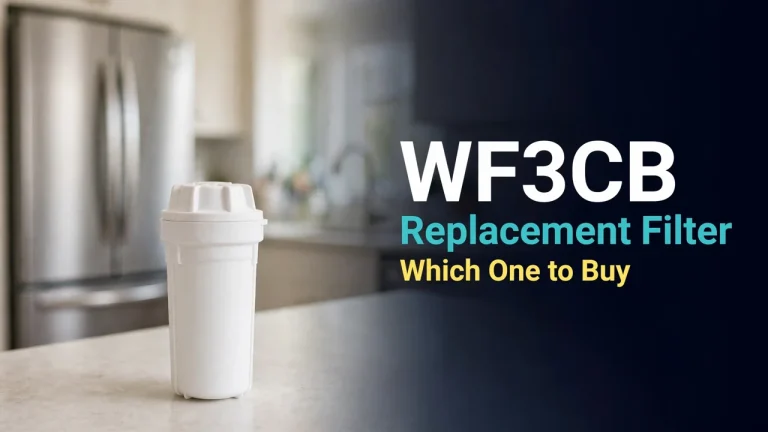
The part number is printed on the old cartridge itself — that label is the ground truth, ahead of the manual and ahead of any listing’s “fits your model” claim. Photograph it before you order. If the cartridge is long gone, the fridge’s model number (on a sticker inside the door frame or behind the crisper) plus the manufacturer’s filter finder gets you the same answer. Our per-model guides cover the big ones step by step: the Samsung DA29-00020B, the LG LT1000P, the GE XWFE, the EveryDrop EDR4RXD1 and the Frigidaire WF3CB.
Genuine vs compatible: the 60-second version
Genuine — buy it when
- The certification matters to you — genuine cartridges carry the brand-stated NSF/ANSI claims (42, and 53/401 on the better ones); compatibles typically list to 42 at best.
- Your fridge checks the filter — chipped models (GE XWFE/RPWFE) are built to read the cartridge.
- Fit has ever been an issue — genuine tolerances are the surest seat and seal.
Compatible — reasonable when
- Your concern is taste on treated municipal water — a listed compatible from an established brand covers chlorine duty for a third of the yearly cost.
- The genuine tier certifies no higher anyway — a few models (Samsung’s DA29 family) state 42 for the genuine cartridge too.
- You verify the listing — a named brand with an IAPMO/NSF listing beats an anonymous multipack every time.
Two cross-cutting facts: a compatible filter does not void your fridge warranty (Magnuson-Moss Warranty Act — the manufacturer would have to prove the filter caused the failure), and the real price gap is yearly, not per-box: roughly $25–50 a year for listed compatibles against $80–120 for the premium genuine cartridges. Each model guide on this site runs its own exact numbers.
Check Current PriceThe replacement, step by step
- Set up. New cartridge out of its packaging, a towel under the filter area, a large jug handy. You do not need to shut off the water for internal cartridges — the housing seals when the cartridge comes out — but know where your shutoff is anyway.
- Remove the old cartridge. Quarter-turn styles twist counterclockwise and pull; push-button grille styles eject with the button; door and ceiling cartridges slide or swing out of their compartment. A little trapped water spills — that is the towel’s job.
- Compare old and new. Same shape, same cap style, same connector. If anything differs, stop here — wrong cartridge, and forcing it can crack the filter head.
- Seat the new cartridge. Push or turn until it stops firmly — most use a quarter-turn clockwise or a straight push until a click. A cartridge that stops short will leak or starve the dispenser.
- Flush. Run 2–4 gallons through the dispenser into the jug (next section), in cycles if your dispenser pauses — and throw away the first batch of ice, which can carry carbon dust.
- Reset the indicator. Hold the button (next section), and write the date on the new cartridge or a fridge note. Future you says thanks.
Flush and reset

The flush is the step people skip and then complain about: a new carbon cartridge holds loose fines and trapped air, so the first water can look gray, sputter, or taste dusty. Two to four gallons — more for Samsung (which specifies 5 gallons in some manuals) and at least 2.5 for LG — clears it. Our flush walkthrough goes deeper. Then the reset: nearly every brand wants a button held for about 3 seconds, but which button varies — Samsung’s Filter Reset (Family Hub: on-screen), LG’s Water Filter button, Frigidaire’s reset on the dispenser panel, and Whirlpool-family sequences that differ by brand. Our reset instructions guide and the all-brands reset roundup list them — and if the light still will not clear, the cartridge usually is not fully seated.
How often — and how to never forget
The rule is six months or the cartridge’s gallon rating (200–300 gallons on most), whichever arrives first — with two honest adjustments. Sediment-heavy water shortens real life (watch the flow, not just the calendar), and a lightly used second fridge stretches it, though even a low-use cartridge should not pass twelve months: carbon sitting in standing water is not improving with age. To never forget: a phone reminder set six months out at each swap, a dated label on the cartridge itself, or a two-pack subscription if your fridge eats a mainstream cartridge — our subscription worth-it analysis runs those numbers.
When a new filter still misbehaves
A fresh cartridge that flows slowly, leaks, or will not reset is almost never a dead cartridge — it is installation. Slow flow after a swap is usually trapped air or a half-seated cartridge (see our slow-flow diagnosis). A drip at the housing is usually the O-ring or a quarter-turn stopped short (see our leaking-filter fix guide). Work the seat before you blame the part.
Conclusion
Refrigerator water filter replacement is a 10-minute, tool-free job whose quality is decided by three unglamorous details: the exact part number off the old cartridge, a full seat, and a real flush. Buy genuine when certification, chips, or fit demand it; buy a listed compatible when the job is taste on treated water. Either way, change it at six months, reset the light, and write the date down — the whole system works on nothing more than that.
Update log
October 2026: Walkthrough published, with flush volumes and reset methods cross-checked against Samsung, LG, GE, Whirlpool and Frigidaire owner documentation.
FAQs
How often should a refrigerator water filter be replaced?
Every 6 months, or at the cartridge’s gallon rating (200–300 gallons for most models), whichever comes first. Sediment-heavy water or heavy ice and water use can exhaust a cartridge sooner — slowing flow is the practical signal — and even a barely used cartridge should not go past about 12 months.
Where is my refrigerator’s water filter located?
One of five places: the upper corner inside the fresh-food compartment, between the crisper drawers, a compartment at the top of the door, the base grille at the bottom front, or inline on the water line behind the fridge. The part number printed on the existing cartridge confirms the replacement regardless of location.
Do I need to turn off the water to change a fridge filter?
For internal cartridges, no — the filter head seals itself when the cartridge is removed, so a normal swap spills only a few spoonfuls of trapped water. Keep a towel handy. External inline filters and any swap involving disconnecting a water line are the exceptions: shut the water off for those.
Why is the water cloudy or sputtering after I change the filter?
Trapped air and loose carbon fines in the new cartridge. Flush 2–4 gallons through the dispenser (some brands specify more) and dump the first batch of ice. If sputtering persists after a proper flush, reseat the cartridge — incomplete seating lets air keep entering the line.
Will a compatible filter void my fridge warranty?
No. Under the Magnuson-Moss Warranty Act, a manufacturer cannot void your warranty for using a third-party filter; it would have to prove the filter caused the specific failure. Buy listed compatibles from established brands rather than anonymous multipacks, and keep your receipts.
Why will the filter light not reset after the replacement?
Usually the reset hold was too short or the cartridge is not fully seated — most brands want a genuine 3-second hold on the correct button, and chip-reading models also need the cartridge home. Reseat the cartridge, then hold the reset again. If your brand uses a two-button or menu sequence, our reset instructions guide lists it.
Can I skip the filter entirely and use the bypass?
Most fridges will run with a bypass plug (sometimes included in the box) or with no cartridge where the design allows, and the water remains your tap water — unfiltered. That is a legitimate choice on a clean municipal supply, but you lose the chlorine and, on certified cartridges, the lead and contaminant reduction the filter existed for.