
How to Test Your Well Water (2026)
Guide
City water arrives with a testing regime behind it — the utility samples constantly and mails you the results every year. Well water arrives with a pump. The EPA’s Safe Drinking Water Act does not cover private wells, which means the entire quality-control department for your home’s water is you. The good news: the job is small, cheap, and mostly a calendar habit — one proper lab test a year, taken the right way, catches the problems that actually matter.
The short answer: send a sample to a certified lab every year for total coliform bacteria, nitrates, total dissolved solids, and pH — the EPA’s core four for private wells — and add a broader panel every few years or whenever anything changes. Home strips can help size treatment equipment, but bacteria and nitrate verdicts belong to a lab, and the sample itself has to be collected correctly or even a lab result misleads.
Table of Contents
Quick verdict
Order a certified-lab panel once a year — mail-in kits from the best well water test kits use the same certified methods as a local lab. Test immediately, whatever the calendar says, after flooding, well repairs, a damaged cap, any change in taste, odor, or color, or when a baby joins the house. Spend your strip-and-meter energy on hardness, iron, and pH for equipment sizing, and let the lab own the safety calls. That split — home tools for tuning, lab for verdicts — is the whole system.
What to test, and how often
| Frequency | Test for | Why |
|---|---|---|
| Every year | Total coliform bacteria (incl. E. coli check), nitrates, TDS, pH | Bacteria and nitrate are the fast-moving risks — septic systems, farming, and surface water change them season to season |
| Every 3–5 years | Hardness, iron, manganese, sulfate, alkalinity, chloride, lead and copper | Sizes and checks treatment equipment; lead/copper reflect your plumbing more than the aquifer |
| Regional / situational | Arsenic, radon, uranium, VOCs, pesticides, fluoride | Arsenic and radon track local geology; VOCs and pesticides track nearby fuel, industry, and agriculture — ask your state or local health department what your area is known for |
| Immediately | Bacteria + nitrate at minimum | After floods, well work, cap damage, a nearby chemical spill, changed taste/odor/color, or recurring stomach illness in the household |
Two of these deserve emphasis. Coliform bacteria are the indicator organism: they signal a pathway between the surface (or a septic system) and your water, and an E. coli positive means fecal contamination — treat it as urgent. Nitrate, capped at 10 mg/L (as nitrogen) in public supplies, is the farm-and-septic contaminant; it is most dangerous for infants, and no taste or smell warns you it is there. Both change faster than anything else in the table, which is why they anchor the annual test.
Know your system first

Before sampling, decide which question you are asking, because it changes the tap you use. A sample drawn at the pressure tank spigot or the tap before any treatment measures the well itself — the right sample for bacteria, nitrate, and aquifer questions. A sample at the kitchen tap measures what your family drinks, after softeners and filters have had their say — the right sample for checking that treatment works and for plumbing metals like lead and copper. Many owners take both once, learn the gap between them, then default to the kitchen tap for the annual panel. While you are at the tank, note the setup in your test records: well depth if you know it, treatment equipment installed, and the septic tank’s rough distance from the well head (100 feet is the common minimum separation). Future results make far more sense with that context attached.
How to take the sample (step by step)
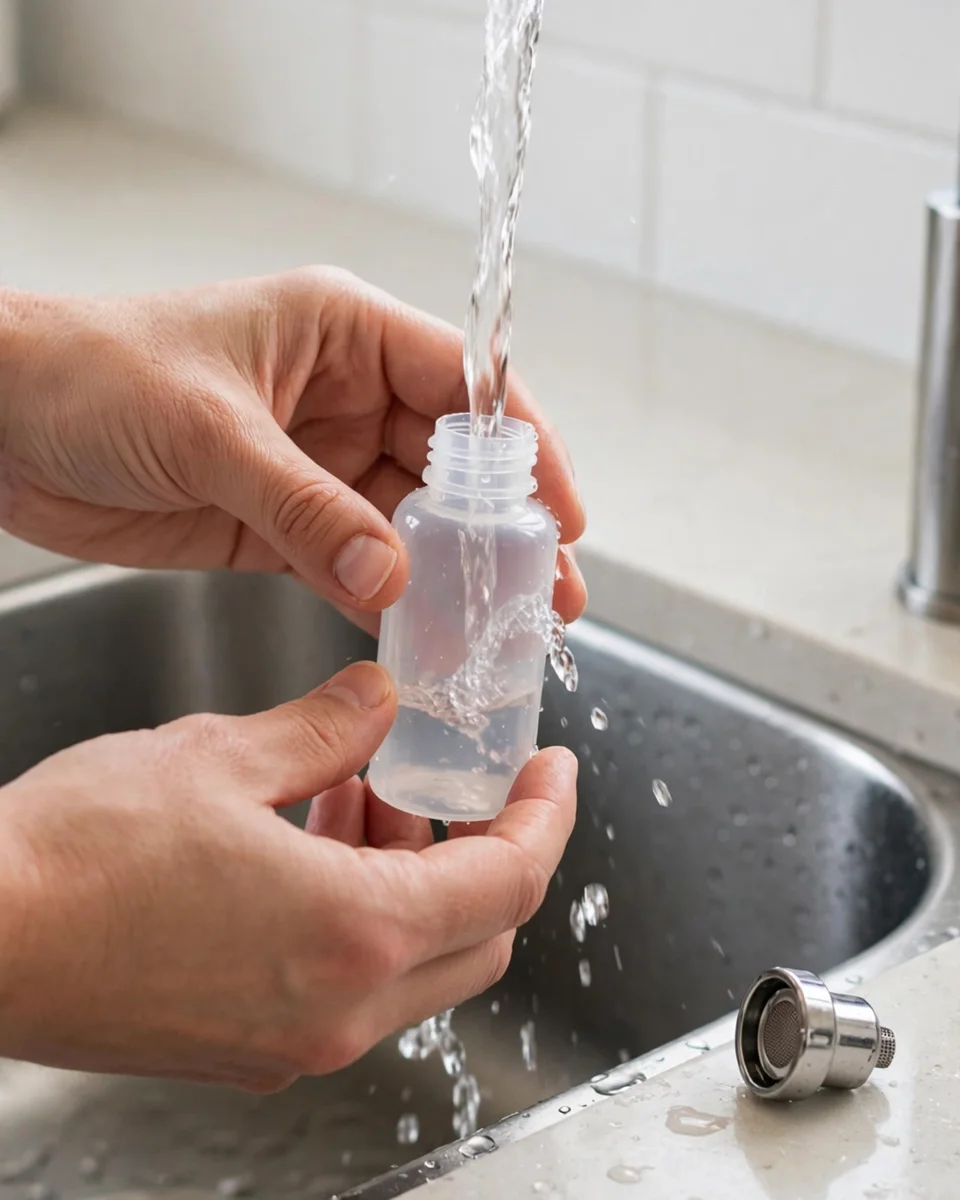
Labs reject or misread more samples over technique than over water quality. Follow the lab’s own sheet first — it overrides everything below — then these universals:
- Use the lab’s bottles. Bacteria bottles are sterile and contain a chlorine neutralizer; metals bottles may contain preservative. Never rinse them, and never substitute a jam jar.
- Pick a cold-water tap you drink from, remove the aerator or screen (a common bacteria hideout that can fake a positive), and let the water run 5–10 minutes to clear the plumbing — unless the lab asks for a first-draw sample, which is the specific protocol for lead and copper.
- Sanitize per the lab’s instructions — many ask you to wipe or flame the tap outlet for bacteria samples. Follow their method, not a neighbor’s.
- Fill without touching the inside of the cap or bottle neck, don’t set the cap face-down, and cap immediately. For bacteria, leave the small headspace the bottle is designed for.
- Label and log each bottle: tap location, date, time, and whether treatment was bypassed. You will thank yourself when the report lands.
Getting it to the lab

Bacteria samples are alive, and the clock runs from the moment you fill the bottle: refrigerate (don’t freeze) and deliver the same day — labs generally want analysis started within about 24 hours, and a sample that rode around in a warm car all weekend can grow a result your well never had. Mail-in kits solve this with prepaid overnight shipping and ice packs; sample on the kit’s recommended weekday so the box never sits in a depot over a weekend. Costs, as typical 2026 estimates: a bacteria test alone often runs $25–50, nitrate similar, and broad certified panels $150–400 depending on how many analytes you add — the comprehensive panels in the best water test kits roundup sit in that range and beat driving to a county lab for most owners.
Reading the results
Results that mean “system healthy”
- Coliform absent — the single most important line on the page.
- Nitrate comfortably under 10 mg/L (as N) and stable versus last year.
- pH in the 6.5–8.5 band; TDS steady at your well’s usual level.
- Iron, manganese, hardness unchanged — your treatment sizing still fits.
Results that mean “act”
- E. coli present: stop drinking it untreated, retest to confirm, inspect the cap and septic distance, shock-chlorinate, and retest again.
- Nitrate over 10 mg/L: do not boil (boiling concentrates nitrate); use RO or ion exchange for drinking water, especially for infants, and find the source.
- Sudden TDS or chloride jump: something changed — road salt, a failing septic, a new pathway. Investigate rather than just treat.
- Lead or copper high at the tap but not at the tank: the plumbing is the source — fixture and solder questions, not well questions.
Keep every report. A single result is a snapshot; five years of them are a diagnosis — slow nitrate creep and seasonal bacteria patterns only show up in the series. And remember the division of labor from our home test vs lab test guide: if a strip or meter reading at home surprises you, the lab panel is how you confirm it before spending on treatment — the same order of operations as testing before buying a filter anywhere else in the house.
Conclusion
Testing well water is a small, fixed ritual: the core four at a certified lab every year, a wider panel every few years, an extra test whenever the well, the weather, or the water changes. The technique matters as much as the test — sterile bottle, right tap, same-day delivery — because a careless sample manufactures problems or hides real ones. Do that, file the reports, and you have given your private well the one thing city water gets for free: someone competent watching it.
Update log
October 2026: Guide published; schedule and sampling protocol follow EPA guidance for private drinking water wells (annual coliform, nitrate, TDS, pH) and standard certified-lab practice.
FAQs
How often should well water be tested?
At least once a year for total coliform bacteria, nitrates, TDS, and pH — the EPA’s core recommendation for private wells. Add a broader panel (metals, hardness, iron, regional items like arsenic) every three to five years, and test immediately after flooding, well repairs, or any change in taste, odor, or color.
Can I test well water with home strips instead of a lab?
Strips are fine for the tuning numbers — hardness, iron, pH — that size treatment equipment. They are not a substitute for the annual lab test: as our strip accuracy guide explains, their color bands are too coarse for bacteria (which they cannot detect at all) and marginal for nitrate decisions at the 10 mg/L line. Screen at home; certify at the lab.
Where do I get a well water test?
Through a state-certified laboratory — your state or county health department usually keeps a list and sometimes runs a lab itself. Mail-in kits that send your samples to certified labs are equally valid and often simpler; the key word on any option is “certified,” which guarantees approved methods and defensible detection limits.
What does a coliform-positive result mean?
Total coliform are indicator bacteria: their presence says a pathway exists between the surface environment and your water. If E. coli specifically is present, that indicates fecal contamination and the water should not be drunk untreated. The standard response is to confirm with a retest, inspect the well cap and septic separation, shock-chlorinate the well, and retest until clear.
Should I sample before or after my softener and filters?
Both answer different questions. Sample before treatment (at the pressure tank) to judge the well itself — bacteria, nitrate, raw chemistry. Sample after treatment at the kitchen tap to verify your equipment works and to catch plumbing metals like lead and copper. For the annual safety panel, the raw sample is the more informative default.
How much does well water testing cost?
As 2026 estimates: individual certified tests like bacteria or nitrate typically run $25–50 each, and broad mail-in panels covering dozens of contaminants run roughly $150–400. Compared with the cost of treating the wrong problem — or missing the right one — the annual panel is the cheapest insurance a well owner buys.