AquaBliss Shower Filter Review (2026): Is It Worth It?
★ BUDGET INLINE PICKYou step out of the shower and your skin feels tight and itchy, and your hair smells faintly of a swimming pool. City chlorine does that. The obvious fixes all sound like work: a whole-house system, a plumber, or swapping the shower head you already like for a bulky filtered one you might not.
Here is the short answer: the AquaBliss SF100 is the cheap, low-effort way to cut down shower chlorine. It is a small inline cylinder, about $35 to $40 (estimate), that threads onto your existing shower arm in a couple of minutes, and you keep your own shower head. AquaBliss markets it as a chlorine reducer for skin and hair — a vendor claim, not an NSF-certified one, and this review will be blunt about that gap. It also does not soften hard water, and no inline filter in this class does. What follows is what the SF100 is made of, what its cartridge really costs per year, and what thousands of owners actually complain about, so you can decide if the low price is a bargain or a false economy.
Our scores
Table of Contents
Quick verdict
The bottom line: the AquaBliss SF100 is the right buy if you want to reduce the chlorine smell and feel of city water for the lowest possible cost, while keeping the shower head you already own. It is not the right buy if you want certified contaminant removal or softer water — it offers neither, and no filter at this price does.
Verdict: the best cheap first step for chlorine-heavy city water, as long as you know exactly what it cannot do.
Price checked at time of writing; it changes often — see the live price before you buy.
Why you should trust this review
We did not receive a test unit and we did not run a lab bench test. Claiming hands-on testing we never did would be dishonest, so we will not do it.
What we did instead was research and comparison: we pulled AquaBliss’s own product and cartridge listings, checked the SF100’s certification claims against the public NSF database, compared published specs against rival inline filters and filtered shower heads, and read owner reviews across major retail listings to find the complaints that keep repeating. Where a claim comes only from AquaBliss’s marketing, this review labels it a vendor claim.
How we researched
- Compared specs across rival shower filters — the SF100 against the Jolie and Canopy filtered shower heads, plus the Sprite and Weddell Duo inline filters buyers cross-shop most.
- Checked certification claims in the public NSF database — we looked for an NSF listing for the SF100 itself, and for what the brand actually claims on its own product pages.
- Read owner reviews across major retail listings — looking for recurring complaints (the same problem mentioned by many owners over many months), not one-off bad experiences.
- Calculated yearly filter-cost math — from the brand’s listed cartridge price and its stated 3-to-6-month replacement window.
Pros and cons
Pros
- Lowest-cost way in — around $35 to $40 (estimate) upfront, the cheapest serious option in the category.
- Keeps your own shower head — inline design means your spray pattern, pressure feel, and bathroom look stay exactly as they are.
- Two-minute, tool-free install — hand-tightens onto a standard half-inch shower arm; renters can remove it without a trace.
- Cheap cartridges — the SFC100 replacement is listed at $18.99 on AquaBliss’s own store, among the lowest per-year costs we found.
Cons
- No NSF certification — we found no NSF listing for the SF100; every performance claim is the brand’s own.
- Does not soften water — hard-water scale and spots will stay exactly as they are.
- Pressure drop and clogging reports — a recurring owner complaint, especially in sediment-heavy water.
- Drops your shower head lower — the housing adds several inches to the arm, which tall users in low-ceiling showers notice.
Certifications (database-checked)
This is the section most SF100 reviews skip, so let us be precise. NSF/ANSI 177 is the standard written for shower filters — it covers aesthetic claims like free chlorine reduction under set test conditions. We checked for the SF100 in the public NSF listings and found no certification for the assembled filter, and AquaBliss’s own product pages do not claim one. What the brand does publish is the cartridge recipe: calcium sulfite, redox media (the KDF family), activated carbon, plus Vitamin C ceramic beads, tourmaline, and zeolite, with stainless mesh and PP cotton catching sediment at both ends. Treat every number below as a vendor claim unless the source column says otherwise.

| Contaminant | Claimed certification | Source |
|---|---|---|
| Chlorine | Vendor-claimed reduction — not NSF certified | AquaBliss product listing (brand-stated) |
| Sediment | Vendor-claimed reduction via mesh and PP cotton layers | AquaBliss cartridge listing (brand-stated) |
| Odor | Vendor-claimed reduction via activated carbon | AquaBliss product listing (brand-stated) |
| Lead and heavy metals | No certified claim — do not rely on this filter for metals | No NSF listing found for the SF100 |
| Water hardness (calcium and magnesium) | Not reduced — this is not a water softener | General chemistry: softening requires ion exchange |
Certification covers only the contaminants in a database entry, and only under standardized test conditions. The SF100 has no such entry, so its chlorine reduction is a brand claim supported by owner experience, not a certified figure. And a plain-language warning that applies to this whole category: reducing chlorine is not the same as softening water. Softening means removing calcium and magnesium through ion exchange, which a small inline cartridge like this does not do.
Design and usability
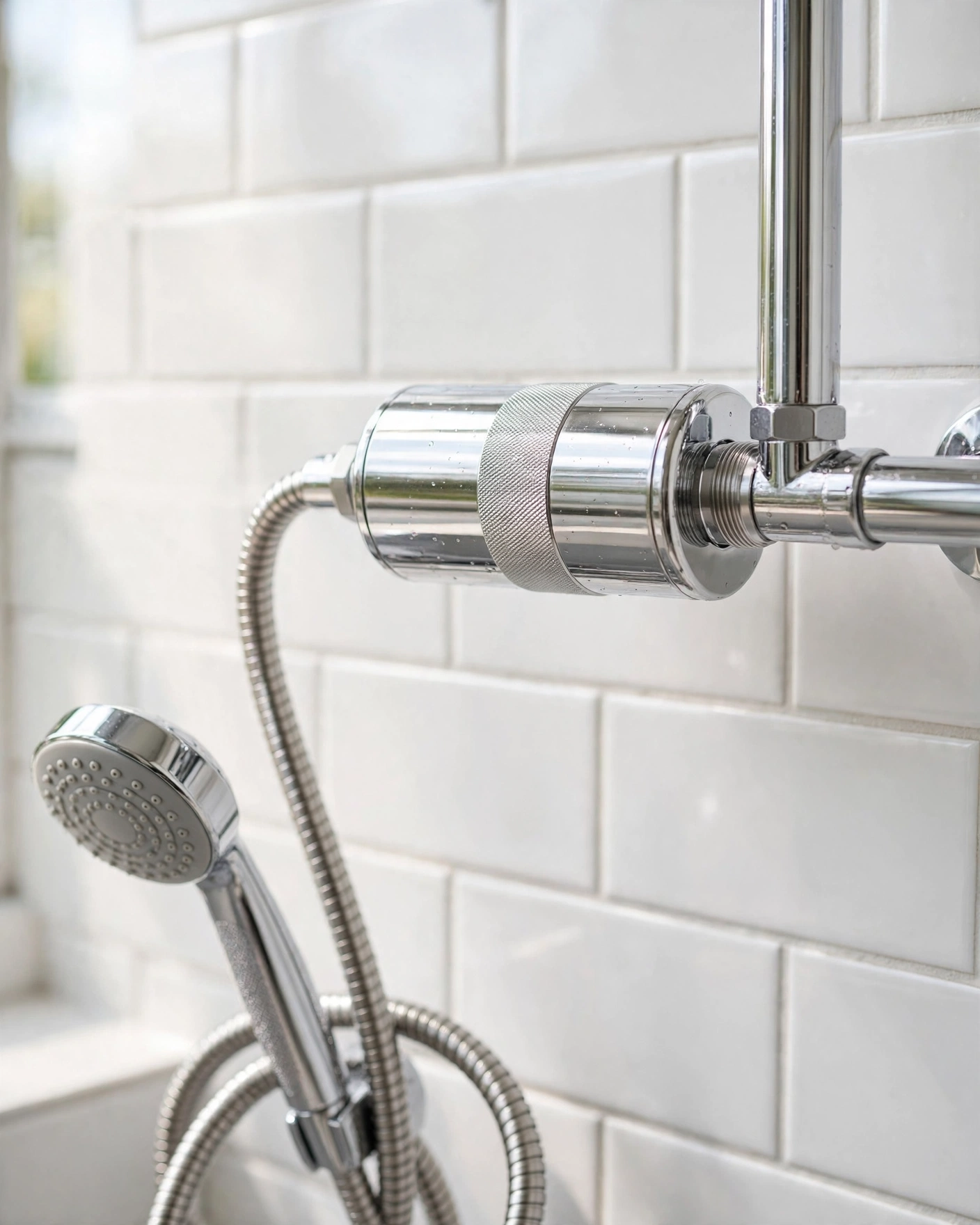
The SF100 is a short chrome-finish cylinder that screws onto the shower arm, and your existing head screws onto the bottom of it. That is the whole installation: AquaBliss says hand-tighten only, and owners agree it takes about two minutes with no tools. Because it is inline, it works with fixed, rain, handheld, and combo heads — the filter decision stays separate from the shower-head decision. If you would rather replace the whole head with a single designer unit, our Jolie shower head review covers the beauty-led option, and the Canopy shower filter review covers the design-led one with spray settings.
Two everyday trade-offs show up in owner feedback. First, the housing adds several inches of length to the shower arm, so the head sits noticeably lower — fine in most showers, annoying if you are tall or the ceiling is low. Second, flow: the brand designs the cartridge to work with your existing flow rather than boost it, and most owners report little change at first. Where pressure does fall, it usually traces back to the cartridge loading up with sediment, which is a replacement signal, not a defect. Hand-tightening matters too: owners who used a wrench report cracked housings and slow leaks at the seam.
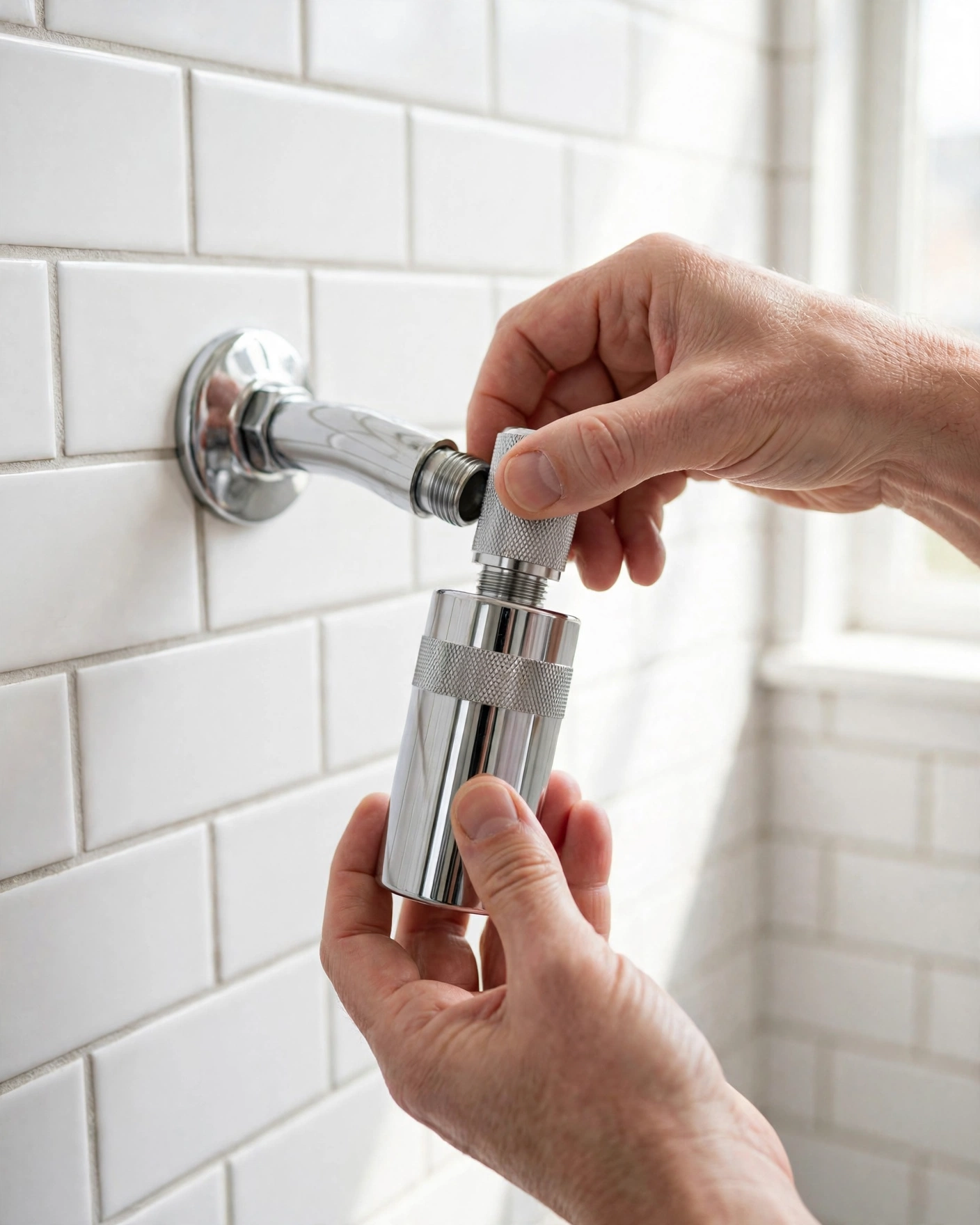
Cartridge swaps are the easiest in the category: unscrew the housing, slide the old SFC100 out, drop the new one in — it fits either direction. AquaBliss advises rinsing a fresh cartridge for about a minute each way first to flush loose carbon dust, a step worth doing unless you enjoy grey water in your first shower.
Filter cost math
The sticker price is the least important number here. What matters is the cartridge habit, and the SF100’s is the cheapest we found in this category:

| Item | Figure |
|---|---|
| Filter (upfront) | ~$35–40 (estimate) |
| Replacement cartridge (SFC100) | $18.99 (brand store listing) |
| Cartridge rated life | 3–6 months, depending on water quality (brand-stated) |
| Cartridges per year | 2–4 |
| Estimated yearly filter cost | ~$38–76 |
Read the range honestly: households with clean city water land near the low end, changing twice a year; hard or sediment-heavy water pushes you toward quarterly swaps and the high end. Even at the high end, the SF100 undercuts every filtered shower head on running cost — the full head-to-head math is in our AquaBliss vs Jolie comparison. The catch is not money, it is discipline: an exhausted cartridge you keep showering through is just a chrome ornament, and the only reminder is the calendar.
What owners complain about
Clogging and pressure drop. The number-one recurring complaint: in sediment-heavy or very hard water, owners report the cartridge loading up within weeks, with flow dropping until the cartridge is swapped. The brand’s 3-to-6-month window assumes average water; well water and old plumbing shorten it fast.
Cracked housings and seam leaks. A persistent second thread: the plastic housing cracks when owners tighten it with a wrench instead of by hand, and a few report slow drips at the seam. Annoying and avoidable — but fair to call the build unforgiving.
The head sits lower, and hard water stays hard. Owners in low-ceiling showers dislike the several inches the housing adds, and a steady stream of one-star reviews comes from buyers who expected softer water and fewer scale spots. That is a category misunderstanding, not a product failure — if scale is your problem, look at the Weddell Duo shower filter review and the Sprite shower filter review with the same warning in mind: no inline filter softens water.
Who should buy it
Buy it if
- You want the cheapest credible way to cut shower chlorine smell and feel.
- You like your current shower head and refuse to give up its spray pattern.
- You are a renter — two-minute install, two-minute removal, no trace left behind.
Skip it if
- You want certified contaminant removal — the SF100 has no NSF listing; look at certified systems instead.
- Your problem is hard water and scale — this filter does not soften, full stop.
- Your water is heavy with sediment — expect clogged cartridges and pressure drop.
The specs
- Brand
- AquaBliss
- Model
- SF100 (Daily Revitalize)
- Type
- Inline shower filter
- Filter media
- Calcium sulfite, redox media, activated carbon (brand-stated)
- Cartridge
- SFC100
- Cartridge life
- 3–6 months (brand-stated)
- Fitting
- Standard 1/2″ shower arm
- Certifications
- None found in NSF database
- Typical price
- ~$35–40 (estimate)
- Warranty
- 12 months (per independent reviewers)
FAQs
How often do I need to replace the AquaBliss SF100 cartridge?
AquaBliss advises replacing the SFC100 cartridge every 3 to 6 months, depending on your water quality. Clean city water usually reaches the longer end of that window. Hard or sediment-heavy water loads the cartridge faster, and the practical signs are a chlorine smell creeping back and a shower that feels weaker than it used to. When either shows up, the cartridge is done, whatever the calendar says.
Does the AquaBliss SF100 reduce water pressure?
It is not supposed to. The cartridge is designed to work with your existing flow, and most owners report little or no change after installing it. When pressure does drop, the usual cause is a cartridge clogged with sediment, which means it is due for replacement. A sudden big drop right after installing usually means the housing was over-tightened or a washer is seated crooked.
Will the AquaBliss SF100 fit my shower head?
In almost every case, yes. The SF100 threads onto a standard half-inch shower arm, and your existing head threads onto the bottom of the filter. AquaBliss lists it as compatible with fixed, rain, handheld, combo, and dual shower setups. The one fit question worth checking is height: the housing adds several inches, so measure if your shower head already sits low.
Does the AquaBliss SF100 soften hard water?
No. The SF100 does not soften water, and neither does any small inline shower filter. Softening means removing calcium and magnesium through ion exchange, which takes a dedicated softener with a resin bed. The SF100 targets chlorine and sediment instead. If white scale spots and stiff laundry are your problem, a shower filter of any brand is the wrong tool for that job.
Is the AquaBliss SF100 NSF certified?
We could not find an NSF certification listing for the SF100 in the public NSF database, and AquaBliss does not claim one on its product pages. The brand publishes what is inside the cartridge and markets chlorine reduction, but those are vendor claims, not certified figures. If a certified listing matters to you, check the NSF database for the exact model before buying any shower filter.
Why does the AquaBliss cartridge change color over time?
Owners often notice the cartridge media darkening over the first weeks of use. That is the media doing its job: the sediment layers trap what they catch, and the redox and carbon media change appearance as they react with chlorine. Visible darkening on its own is not a failure signal. Treat smell returning and flow dropping as your real replacement signals instead.
Can I install the AquaBliss SF100 in a rental apartment?
Yes, and it is one of the better rental upgrades in this category. Installation is hand-tightening the filter onto the shower arm, with no tools and no permanent changes. Removal is the reverse, and the original head goes straight back on. Just keep the original washers from your shower head in a safe place so the landlord gets exactly the shower you found.
How does the AquaBliss SF100 compare with the Jolie on running cost?
The AquaBliss is far cheaper to run. Its SFC100 cartridge lists at $18.99 on the brand store and lasts 3 to 6 months, so a year of filters costs roughly $38 to $76. The Jolie head costs far more upfront, and its filters run about $38 each on a 90-day cycle, roughly $152 a year. You pay the Jolie premium for design and a dedicated head, not for cheaper filtration.
Conclusion
The AquaBliss SF100 is the right buy for one clear reader: the person whose shower smells of chlorine, whose skin feels it, and who wants the cheapest honest fix that keeps their own shower head. For that reader, roughly $35 to $40 upfront and under $76 a year buys a real quality-of-life upgrade. For everyone else — the hard-water household, the certification-first buyer, the design lover — it is the wrong product wearing a bargain price tag. Know which reader you are, and the choice makes itself.
Price checked at time of writing; it changes often — see the live price before you buy.
Update log
- Zulqarnain: Review published.