
Best Shower Filters (2026): What They Can and Can't Do
Shower filters
Step into your shower and it smells like a swimming pool. Your skin feels tight and itchy afterward — and every product page has the same answer: buy a shower filter and enjoy spa water. Half of that promise is marketing.
Here is the honest version. A good shower filter does one thing well: it cuts chlorine. That alone can change how your shower smells and feels. It will not soften hard water, it will not make water safe to drink, and no showerhead turns tap water into a spa treatment. Once you accept that, picking the right filter gets simple. Below: the picks that do what they claim, how to choose, and the hard limits every honest review should tell you.
Table of Contents
Quick Picks
Short on time? Four filters worth your attention, each for a different buyer. Every price below is an estimate that moves around — check the current price before you buy.
AquaBliss SF100 — the longtime bestseller (about $30–40). An inline multi-stage filter that screws in behind your existing showerhead, so you keep the head you already like. Huge owner base, cheap cartridge swaps, lowest entry price of the bunch.
Check Current Price
Estimated price: ~$30–40 — check the current price before you buy.
Canopy — the design-led pick (about $100–150). An all-in-one filtered showerhead in designer colors and finishes; the brand publishes its own cold-water chlorine test data. You pay for the looks and the brand.
Check Current Price
Estimated price: ~$100–150 — check the current price before you buy.
Jolie Filtered Showerhead — the all-in-one filtered showerhead (about $165–170). No separate canister: the filter lives inside a showerhead you would buy for looks alone. Dead-simple install — at a premium price.
Check Current Price
Estimated price: ~$165–170 — check the current price before you buy.
Weddell Duo — the workhorse (about $80–100). Weddell rates its cartridge at 8,000 gallons per set, which matters if your water is rough on filters. It carries an NSF/ANSI 177 listing — look it up on info.nsf.org yourself before you trust the badge.
Check Current Price
Estimated price: ~$80–100 — check the current price before you buy.
What Shower Filters Can and Can’t Do
Most shower filter pages skip this: a shower filter is good at one job and useless at three others. Know the split before you spend a dollar.
What they do
- Reduce free chlorine. This is the real job. City water is chlorinated to stay safe in the pipes, and that chlorine is what makes your shower smell like a pool. Carbon, KDF-style, and vitamin C media all target chlorine first.
- Improve the smell and feel of the shower. Less chlorine usually means less chemical smell and less of the tight, dry-skin feeling after a hot shower. Owners notice this within the first week.
- Catch some sediment. Many cartridges include a sediment layer that traps rust flakes and pipe grit. A small bonus, not a headline feature.
What they don’t do
- They do not soften hard water. A shower filter is not a water softener. It does not remove the calcium and magnesium minerals behind limescale, soap scum, and white spots on glass. If your fixtures crust over, you need a softener — not a better shower filter.
- They do not make water safe to drink. Chlorine reduction is an aesthetic fix, not purification. Fluoride, lead, and other contaminants are outside a shower filter’s job description.
- They do not turn tap water into “spa water.” That is marketing copy, not chemistry. Expect a better-smelling shower, not a transformation.
So where does each problem send you? White scale on fixtures and glass means hard water — that is a whole-house water filter and softener conversation. Want genuinely clean drinking water? That happens at the sink with an under-sink reverse osmosis system. The shower filter owns the middle ground: the chlorine smell and the shower feel.
On certifications: most shower filters carry no third-party certification at all. If a brand claims an NSF or WQA listing, look it up on info.nsf.org yourself — a badge on a product page is a claim, a database listing is proof.
How to Choose a Shower Filter
There are only a few real decisions here. Get these right and the rest is decoration.
Filter media: carbon, KDF-style, or vitamin C
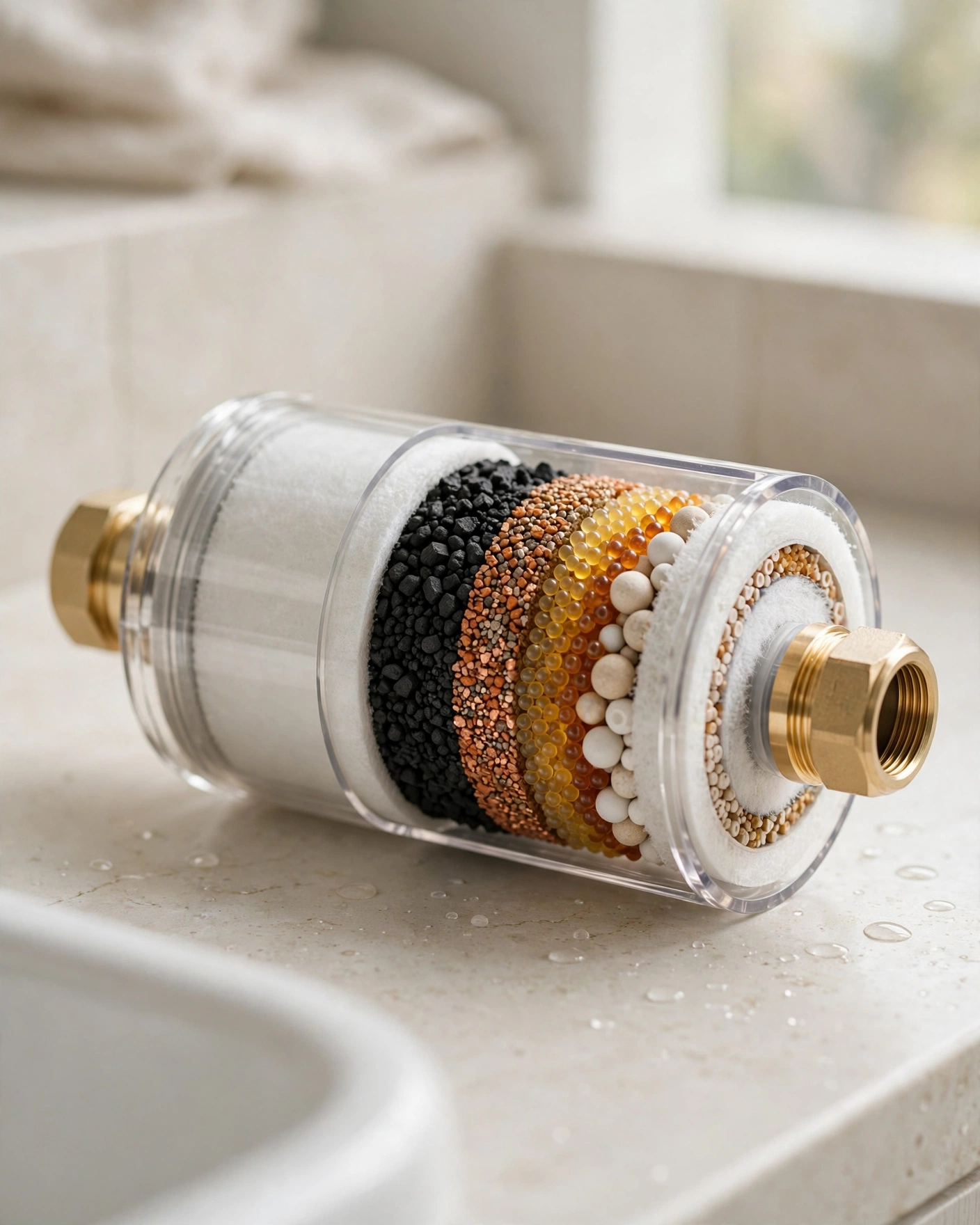
Carbon block is the old reliable — chlorine sticks to activated carbon as water passes through, and it does this quietly for months. KDF-style media (a copper-zinc blend) also targets chlorine and is often paired with carbon in multi-stage cartridges like the AquaBliss. Vitamin C neutralizes chlorine fast, but its cartridges burn through quicker and cost more per month. In plain terms: carbon and KDF blends are the set-and-forget options; vitamin C is the sprinter.
The hot-water caveat
Media behave differently in hot water than cold — chlorine reduction is generally stronger in cooler water. If the smell is what bothers you, a warm shower gets more from your filter than a scalding one. (Brand lab numbers vary and must be re-checked at publish time, which is why none are printed here.)
Flow rate and pressure
Every inline filter adds a little resistance. Good designs keep the drop small; clogged ones make your shower feel anemic. Check the product’s flow note and read the troubleshooting section before blaming the filter — most “pressure problems” are a flow restrictor or a badly seated cartridge.
Cartridge life and refill lock-in
A filter is a subscription you did not sign up for. Cartridges last a few months; the real question is what refills cost and whether anyone else sells them. Universal cartridges let you shop around; proprietary ones (Canopy and Jolie) lock you into one brand’s pricing. Multiply refill price by replacements per year before a bargain price tag wins you over.
Inline vs. filtered showerhead
Inline filters (AquaBliss, Weddell) screw in behind your existing head — keep the head you like, hide the filter. Filtered showerheads (Jolie, Canopy, Cobbe) replace the head entirely — cleaner look, but you are stuck with that spray pattern. Renters tend to prefer inline units since they come off without a trace.
Check the certification yourself
NSF/ANSI 177 is the standard covering shower filtration, and very few products are listed — which is why a listing is worth checking. Go to info.nsf.org, search the brand and model, and see if it is really there. If not, treat any badge on the box as decoration.
A shower filter is one room’s answer to a whole-house question. For the full picture, the nine filter types overview places shower filters alongside pitchers, under-sink, and whole-house systems.
Top Picks: Mini-Reviews
Four picks, four buyers. Specs and prices are estimates — re-verify on the product page, since listings change. Method in one line: bestseller lists and long-term owner reviews were cross-checked against the few third-party certifications that exist, and anything sold on a claim it can’t back (like hard-water “softening”) was cut.
AquaBliss SF100 — Best Overall
The SF100 is the shower filter most people end up with: about $30–40, fits any standard half-inch shower arm, and has one of the largest owner bases in the category. Its multi-stage cartridge layers sediment, carbon, and KDF-style media aimed at chlorine, and it screws in behind your existing showerhead.
Pros
- Lowest entry price of any serious pick.
- Universal fit — keep your existing showerhead.
- Huge review base — real-world fixes are well documented.
Cons
- Plain plastic housing — not a looker.
- Skip the cartridge swap and the chlorine smell returns.
- Less effective in very hot showers.
Common complaint + owner fix: the top gripe is that the filter “stops working” after a few months — the cartridge is simply spent. Fix: set the replacement date in your phone on install day, and buy the refill two-pack up front.
Estimated price: ~$30–40 — check the current price before you buy.

Canopy — Best Design
Canopy is the pick for people who care what their shower looks like: an all-in-one filtered showerhead in designer colors and finishes, with the brand publishing its own cold-water chlorine test data (re-verify at publish time — brand lab data is brand lab data). At about $100–150 (flagship $150, compact Mini $99) it costs three to four times what the AquaBliss does, and proprietary filters lock you into Canopy’s refill pricing.
Pros
- Best-looking showerhead in the category.
- Flagship, handheld, and compact Mini models.
- Brand publishes its own cold-water chlorine test data.
Cons
- Premium unit price and proprietary refills.
- No third-party cartridge alternatives.
- Less long-term owner history than the veterans.
Common complaint + owner fix: sticker shock at refill time. Fix: price out a year of Canopy cartridges before buying, and compare against the AquaBliss math in the cost section.
Estimated price: ~$100–150 — check the current price before you buy.

Jolie Filtered Showerhead — Beauty Pick
Jolie builds the filter into a showerhead you would buy for looks alone (about $165–170 — $169 one-time, $148 on the filter subscription). Simplest install here — unscrew the old head, screw on the Jolie — and the obvious pick for the skin-and-hair crowd. The trade-off: Jolie’s spray pattern and proprietary filters, no alternatives.
Pros
- All-in-one: filter and showerhead in a single good-looking unit.
- Easiest install of the four.
- Strong fit for skin-and-hair-focused buyers.
Cons
- You give up your existing showerhead.
- Proprietary replacement filters.
- Pricier per unit of filtration than inline options.
Common complaint + owner fix: the spray pattern is not for everyone. No fix for taste — if you love your current rainfall head, buy an inline filter and keep the head.
Estimated price: ~$165–170 — check the current price before you buy.

Weddell Duo — High Capacity
The Weddell Duo (about $80–100) is the workhorse. Weddell rates its cartridge at 8,000 gallons per set — good if your water chews through filters or you hate swapping cartridges. It carries an NSF/ANSI 177 listing that independent roundups confirm you can look up; still, verify it on info.nsf.org yourself before counting it as a plus. The honest downside is size: a chunky unit, so check your arm clearance if it sits low.
Pros
- High cartridge capacity — fewer swaps per year.
- NSF/ANSI 177 listed — confirm the listing on info.nsf.org.
- Good fit for heavy-use households.
Cons
- Bulky on the shower arm.
- Highest upfront price of the four.
- Utilitarian looks — function over form.
Common complaint + owner fix: the size surprises people. Fix: measure the gap between your shower arm and the wall first; if it is tight, pick the slimmer Canopy or AquaBliss instead.
Estimated price: ~$80–100 — check the current price before you buy.

Pairing your water, room by room: a shower filter only handles the bathroom. For clean drinking water at the kitchen sink, the Geekpure 5-stage RO (about $130–220) is the budget under-sink option; for the fridge dispenser, an EveryDrop EDR4RXD1 (about $45–55) keeps that water tasting right too.
Shower Filter Comparison Table
Side by side. Everything marked with an asterisk is an estimate — re-verify on the product page before you buy.
| Product | Price range* | Media type | Cartridge life* | Flow / pressure note | Cert status | Best for |
|---|---|---|---|---|---|---|
| AquaBliss SF100 | ~$30–40 | Multi-stage (sediment, carbon, KDF-style) | A few months; refills ~$20–25 | Slight restriction, typical inline | No verified listing | Best overall value |
| Canopy | ~$100–150 | Built-in (carbon + KDF-55 + calcium sulfite) | Proprietary refills — check price | Replaces the head; several finishes | No verified listing | Design-conscious buyers |
| Jolie Filtered Showerhead | ~$165–170 | Built-in filter media | Proprietary refills — check price | Replaces the head; fixed spray pattern | No verified listing | Skin-and-hair buyers |
| Weddell Duo | ~$80–100 | High-capacity multi-stage | 8,000 gallons per set | Bulkier; check arm clearance | NSF/ANSI 177 — verify listing | Fewer swaps, heavy use |
* Estimates based on typical listing prices. Prices move — the number on the product page is the only one that counts.
Cost of Ownership
The unit price is the cover charge; the cartridges are the bar tab.
AquaBliss SF100: about $30–40 for the unit, then cartridges at roughly $20–25 each. Most owners swap twice a year — roughly $40–50 a year from year two on. The cheapest serious shower filtration you can buy.
Canopy: about $100–150 up front (flagship $150, Mini $99), then proprietary refills. Check the current cartridge price before you commit — this is the pick where a year of refills can cost as much as the unit itself.
Jolie: about $165–170 up front ($169 one-time, $148 on the filter subscription) — the priciest of the four — with proprietary filters around $33–35 every three months. Weddell: about $80–100 up front; its 8,000-gallon cartridge means fewer purchases per year, which softens the per-cartridge price. Verify current refill prices for both at publish time.
For scale, most households already pay this kind of recurring filter cost: Brita Standard pitcher filters run about $15–30 a pack and Brita Elite replacements about $18–25 each, with most families buying several a year. A shower filter’s annual cost lands in the same neighborhood.
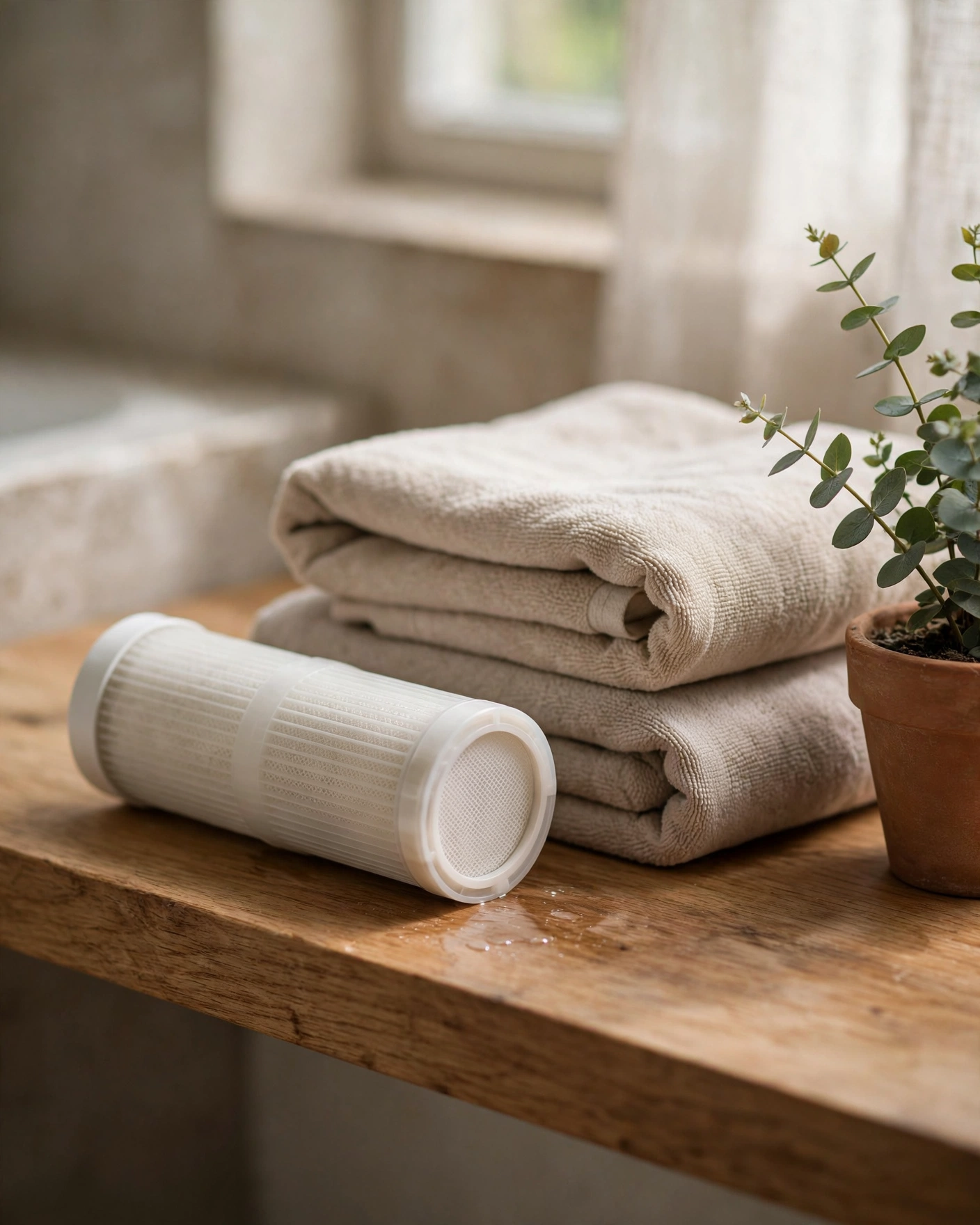
Troubleshooting: Pressure, Leaks and Cartridge Issues
Most shower filter problems are installation problems in disguise. Work through these in order.
Water pressure dropped after installing
An inline filter adds resistance, but a dramatic drop usually has a fixable cause. Check in order: (1) the flow restrictor — many showerheads have a small disc that, combined with a filter, strangles flow; removing it is the most common fix; (2) cartridge seating — a crooked cartridge blocks flow unevenly, so reseat it; (3) sediment — gritty water loads up the sediment layer early; (4) isolate — run the shower with the filter removed. Pressure back means the filter is the bottleneck; if not, it is your plumbing.
Leaking at the threads
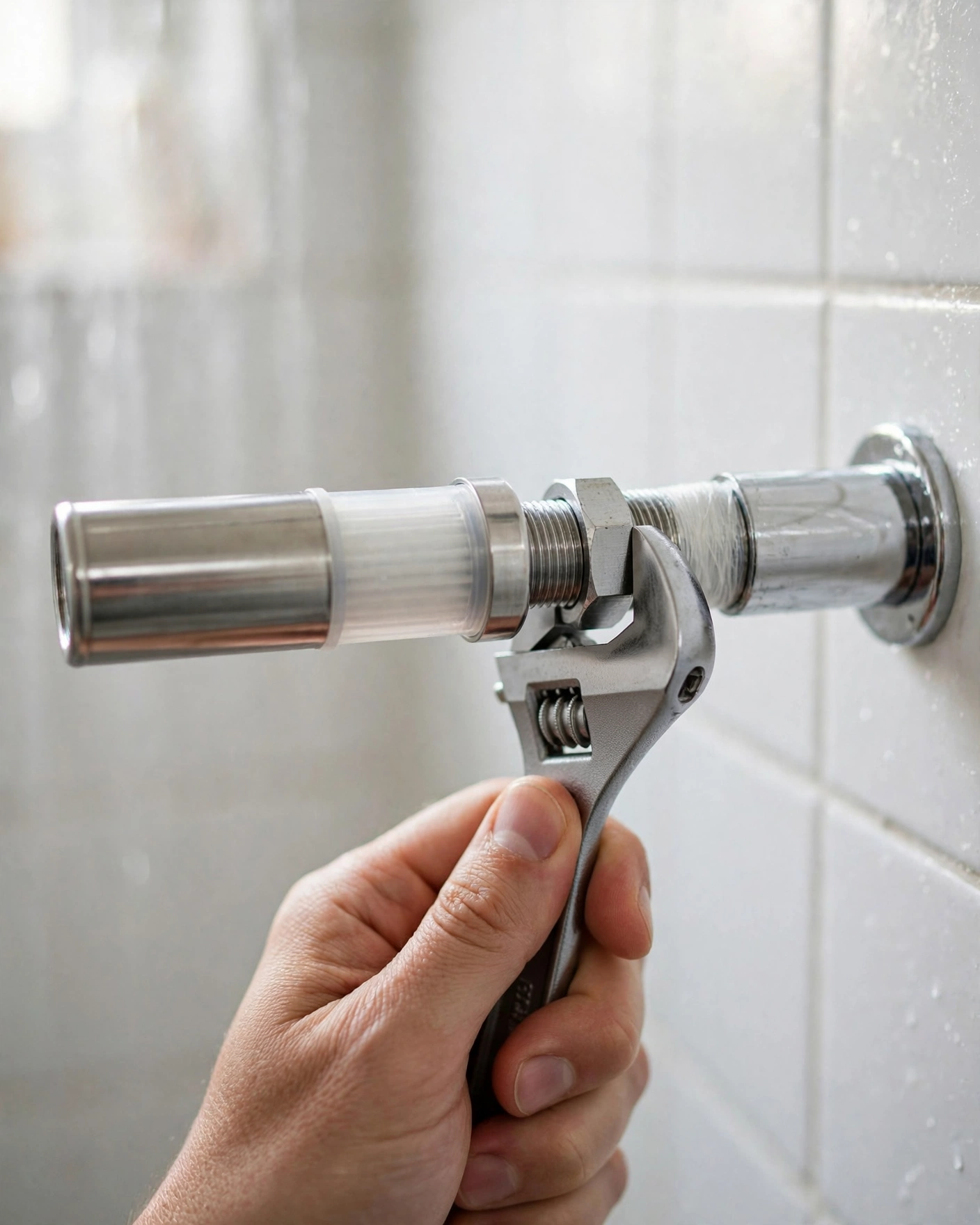
Leaks at the shower arm are almost always a sealing issue. Wrap the arm’s threads with PTFE tape (three to four turns), seat the rubber washer flat inside the filter’s inlet, then tighten by hand plus a quarter turn with a wrench. Do not over-torque — cracked housings come from enthusiasm, not defects.
When to replace the cartridge
Three signals: the chlorine smell returns, the flow drops, or the calendar hits the brand’s interval. The smell test is the most honest — your nose knows when the media is spent. Do not stretch cartridges past their interval; a saturated cartridge is just a pipe fitting that used to filter.
Shower Filter FAQs
Do shower filters really work?
Yes — within its limits. A shower filter reliably reduces free chlorine, the chemical behind the pool smell and the tight, dry feeling after a hot shower. It cannot soften hard water, remove fluoride or heavy metals, or make water safe to drink. Judge it on the chlorine job and it works.
Do shower filters remove chlorine?
They reduce it — “remove” overpromises. A fresh cartridge cuts the pool smell noticeably. No filter removes 100% under real shower conditions, and very hot water is harder on the media. Expect a strong reduction, not elimination — and swap the cartridge on schedule.
Do shower filters soften hard water?
No — this is the most important thing to know before buying. A shower filter is not a water softener: it does not remove the calcium and magnesium behind limescale, white spots on glass, and soap scum. If your fixtures crust over with scale, you need an actual softener. Buy a shower filter for chlorine, not hardness.
Shower filter vs water softener — which do I need?
Different problems, different tools. Pick a shower filter for the chlorine smell or tight, dry skin. Pick a softener for white scale on fixtures, spots on glass, or stiff laundry — those are hardness minerals, and only a softener removes them. Many homes with hard city water end up with both: the softener for the pipes, the filter for the shower.
How often should I replace a shower filter?
Follow the brand’s interval — typically every two to six months. Your nose is the backup meter: when the chlorine smell returns, the media is spent. Heavy use and rough water burn through cartridges faster. Set the replacement date in your phone on install day.
Why did my water pressure drop after installing one?
The filter adds a little resistance, but a big drop usually means something else. Check the flow restrictor first — combined with a filter it can strangle flow, and removing it is the most common fix. Next, reseat the cartridge. Still low? Shower without the filter: pressure back means the filter is the bottleneck; if not, it is your plumbing.
Are shower filters worth it for well water?
Usually less so. Well water typically is not chlorinated, so the filter’s main job — chlorine reduction — solves a problem you may not have. Well issues tend to be sediment, iron, or sulfur smells, which a shower filter will not fix. Well owners generally get more from whole-house treatment first.
Conclusion
Buy a shower filter if your shower smells like a pool and your skin feels tight afterward — that is the problem these products genuinely solve, and the AquaBliss SF100 solves it for the least money. Skip the fantasy that any showerhead softens water or purifies it; scale on your fixtures means you need a softener, not a fancier filter. Keep the cartridge fresh, keep your expectations honest, and a thirty-dollar canister will quietly do its one job well.