Slow Water Flow After Replacing the Fridge Filter? Causes & Fixes
Guide
The whole point of changing the filter was to get the strong stream back. Instead the new cartridge went in, and the dispenser still crawls — or crawls worse. Before you conclude the new filter is defective (it almost never is), work this list: in our experience the cause is installation or air in roughly nine cases out of ten, and the fixes are free.
The short answer, in the order to check: reseat the cartridge until it fully locks; flush far more water than feels reasonable (air is the silent cause); check for a cap or seal left on the cartridge; confirm you bought the right part number; then look behind the fridge at the valve and line. Only after all five should you suspect the cartridge itself — and one calibration first: many fridge filters are rated around 0.5 gallons per minute, so a healthy filtered stream fills 8 ounces in about 20 seconds. Slower than the old filter at its best is a fault; slower than the tap is normal.
Table of Contents
First, what healthy flow looks like

Run the test before touching anything: time how long the dispenser takes to fill 8 ounces. ~20 seconds is a typical healthy figure for a filtered stream (0.5 gpm class cartridges). 30–45 seconds suggests restriction somewhere. A minute or more, or a stream that dwindles as you dispense, points at air, a half-seated cartridge, or a supply problem. Also note whether the flow was slow before the swap: if the old cartridge was equally slow at the end of its life and the new one is no better, the restriction may never have been the filter at all — work the whole list, including behind the fridge.
Fix 1: reseat the cartridge

The most common cause, by a wide margin. A cartridge that stops a few millimeters short — a quarter-turn that did not finish, a push-fit that never clicked — leaves the internal valve partly closed and the O-rings partly compressed: water squeezes through a gap meant to be fully open. Remove the cartridge completely, inspect the O-rings (round, seated in their grooves, not pinched or doubled), and reinstall with deliberate firmness until the turn stops or the click lands. Then re-run the 8-ounce test. This fix alone resolves the majority of “new filter, slow flow” cases — and the same half-seat is also the top cause of post-change drips, which our leaking-filter fix guide covers.
Fix 2: purge the air properly
A new cartridge is full of air, and air in the line behaves exactly like a blockage: sputtering, a stream that fades in and out, and flow that mysteriously returns after the fridge sits. The cure is a real flush — not the hopeful two glasses many people stop at, but the full 2–4 gallons (some brands specify up to 5), dispensed in cycles: run the dispenser for about 30 seconds, rest 30, repeat. Our flush guide details the technique. Air also explains the classic pattern of “slow right after the change, fine by morning” — the reservoir slowly burps itself. If you have not flushed at least 2 gallons, you have not finished the install yet; do that before suspecting any part.
Fix 3: caps, seals and wrong part numbers
- Shipping caps and plugs. Some cartridges ship with a protective cap over the inlet or outlet stem. Left on, it throttles or blocks flow outright. Compare the new cartridge’s ends with the old one’s — they should look identical.
- The wrong cartridge. Look-alike part numbers (an LT700P in an LT1000P housing, an XWF where an XWFE belongs) can sort-of fit while their ports misalign. Check the number on the cartridge against the number on the old one — the full story is in our replacement walkthrough.
- Anonymous cartridges with undersized ports. Some no-name compatibles mold their stems slightly small or their media overly dense; flow suffers from day one. If the old brand-name cartridge flowed well and everything else checks out, a bargain cartridge is a legitimate suspect — the swap test in the last section proves it.
Fix 4 and 5: behind the fridge
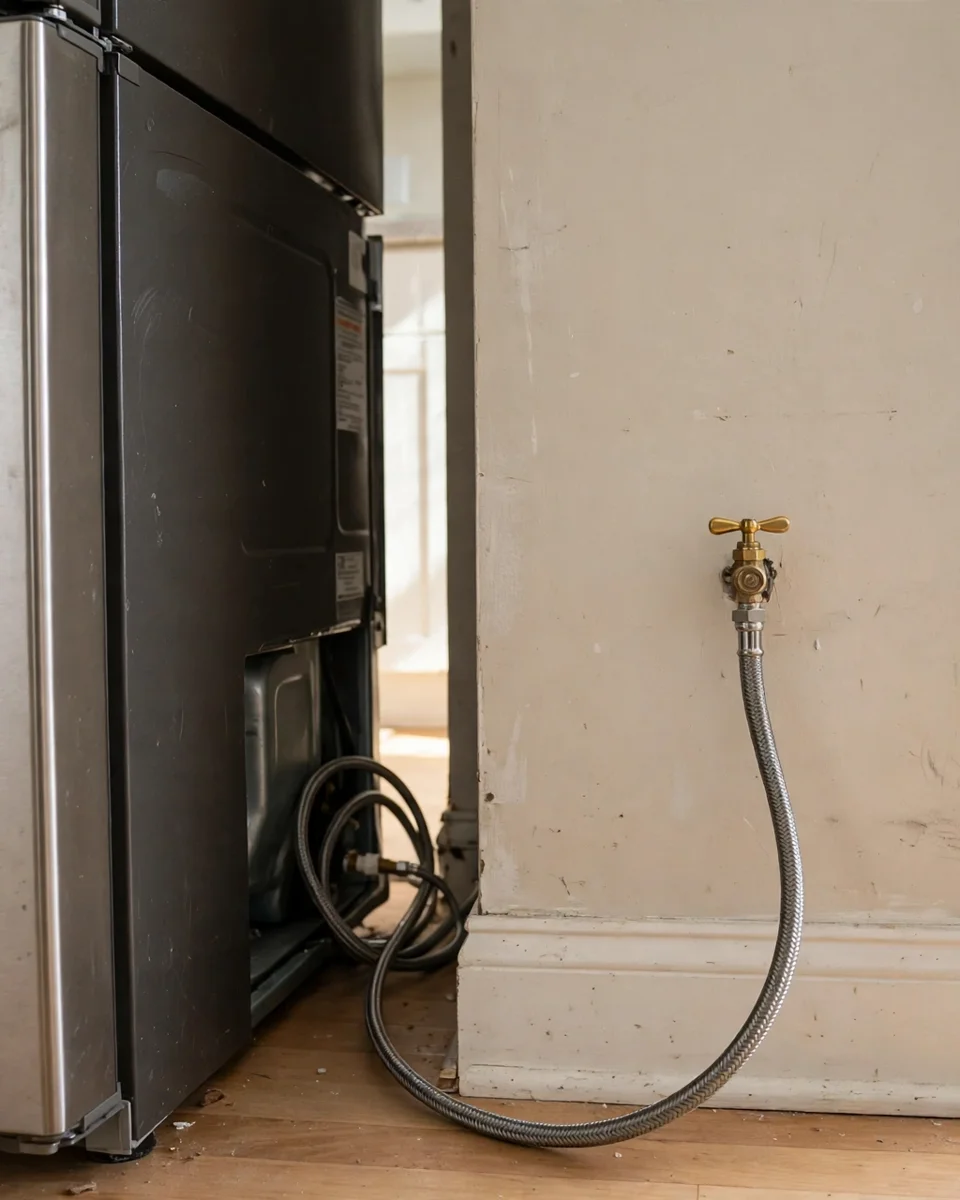
Fix 4 — the shutoff valve. If anyone touched the valve during the swap (or a saddle valve has been slowly clogging with mineral scale for years), the fridge is simply being under-fed. Confirm the valve is fully open. Saddle valves are notorious for exactly this failure; a weak stream at a nearby tap with the fridge disconnected tells the story. Fix 5 — the line itself. Pulling the fridge out and pushing it back can kink a plastic line or pinch it under a leveling foot. Roll the fridge out a few inches, inspect the loop of line behind it, and push back with slack arranged in a gentle curve.
If none of that worked
- The swap test. Reinstall the old cartridge (or the bypass plug, if your model uses one). Flow restored = the new cartridge is the problem; return it as defective — rare for genuine, less rare for no-name. Flow still slow with the bypass = the fridge or supply is the problem, not any filter.
- Frozen reservoir or line. A fridge set very cold can partly freeze the water reservoir or line, narrowing it. Flow that worsens in cold snaps and improves after a small temperature raise points here.
- Failing inlet valve. The fridge’s own water inlet valve can weaken with age; slow flow to both dispenser and ice maker with a proven-good bypass is its signature. That one is a parts-and-service fix, not a filter fix.
Conclusion
Slow flow after a filter change is an installation story far more often than a defective-part story: reseat the cartridge, flush the full 2–4 gallons in cycles, check for caps and wrong numbers, then look at the valve and line behind the fridge. Finish with the 8-ounce test — around 20 seconds is healthy for filtered water — and only blame the cartridge after the bypass swap test proves it. Five free checks before one paid conclusion.
Update log
October 2026: Guide published; flow benchmarks reference the 0.5-gpm class ratings common to mainstream fridge cartridges, and the diagnostic order follows manufacturer troubleshooting sequences.
FAQs
Why is my water flow slower with a brand-new filter?
Most often the cartridge is not fully seated, leaving the filter head’s valve partly closed — remove it and reinstall until the turn stops or the click lands. Next suspects: air still in the line (flush the full 2–4 gallons in cycles), a shipping cap left on the cartridge, or a wrong/undersized compatible cartridge.
How fast should a fridge dispenser flow with a new filter?
Mainstream fridge cartridges are typically rated around 0.5 gallons per minute, which fills an 8-ounce glass in about 20 seconds. Noticeably slower than the old cartridge at its best — 40 seconds and beyond — is worth diagnosing with the steps in this guide.
Can a new filter be defective out of the box?
It happens but is uncommon with genuine cartridges and established compatible brands; it is more frequent with anonymous multipacks whose ports and media density vary. Prove it before returning: run the bypass or old-cartridge swap test — if flow returns without the new cartridge, the cartridge is the restriction.
The flow is fine in the morning but slow right after I dispense a lot. Why?
That pattern points to the chilled reservoir: sustained dispensing empties it, and the refill path through the filter is slower than demand, so the stream fades until the reservoir recovers. Air left after an incomplete flush makes it worse. A proper 2–4 gallon flush usually settles it.
Could my water pressure be the problem instead of the filter?
Yes — a half-open shutoff valve, a mineral-clogged saddle valve, or a kinked line behind the fridge all starve the filter regardless of its condition. The tell is that flow is slow with the bypass plug installed too. Check the valve is fully open and the line runs in a gentle, unkinked curve.
Does a finer filter always flow slower?
Somewhat. Cartridges certified for more contaminant classes pack denser media, and dispenser flow through a 0.5-gpm cartridge will never match the open tap. That is the normal trade. What is not normal is a drop versus your previous cartridge of the same type — that difference is what this guide’s checks address.