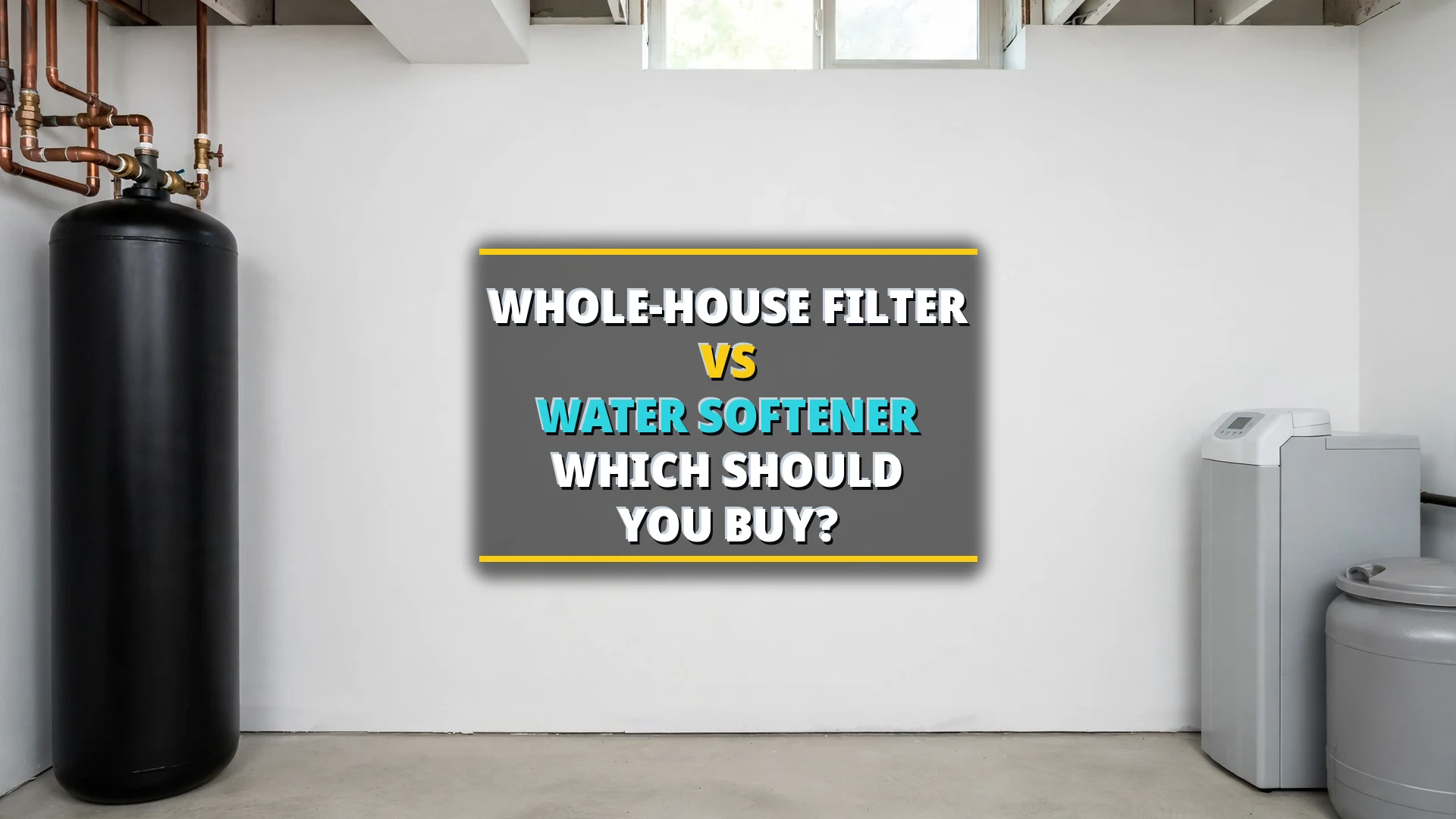

Whole House Water Filter vs Water Softener (2026): Which Should You Buy?
The kettle is crusting up again, the shower door never looks clean, and the tap water smells faintly of a swimming pool. Two machines promise to fix your water — a whole-house filter and a water softener — and sitting in the garage they look like twins: a tall tank, some plumbing, a control head. It is no surprise most buyers treat them as two versions of the same thing.
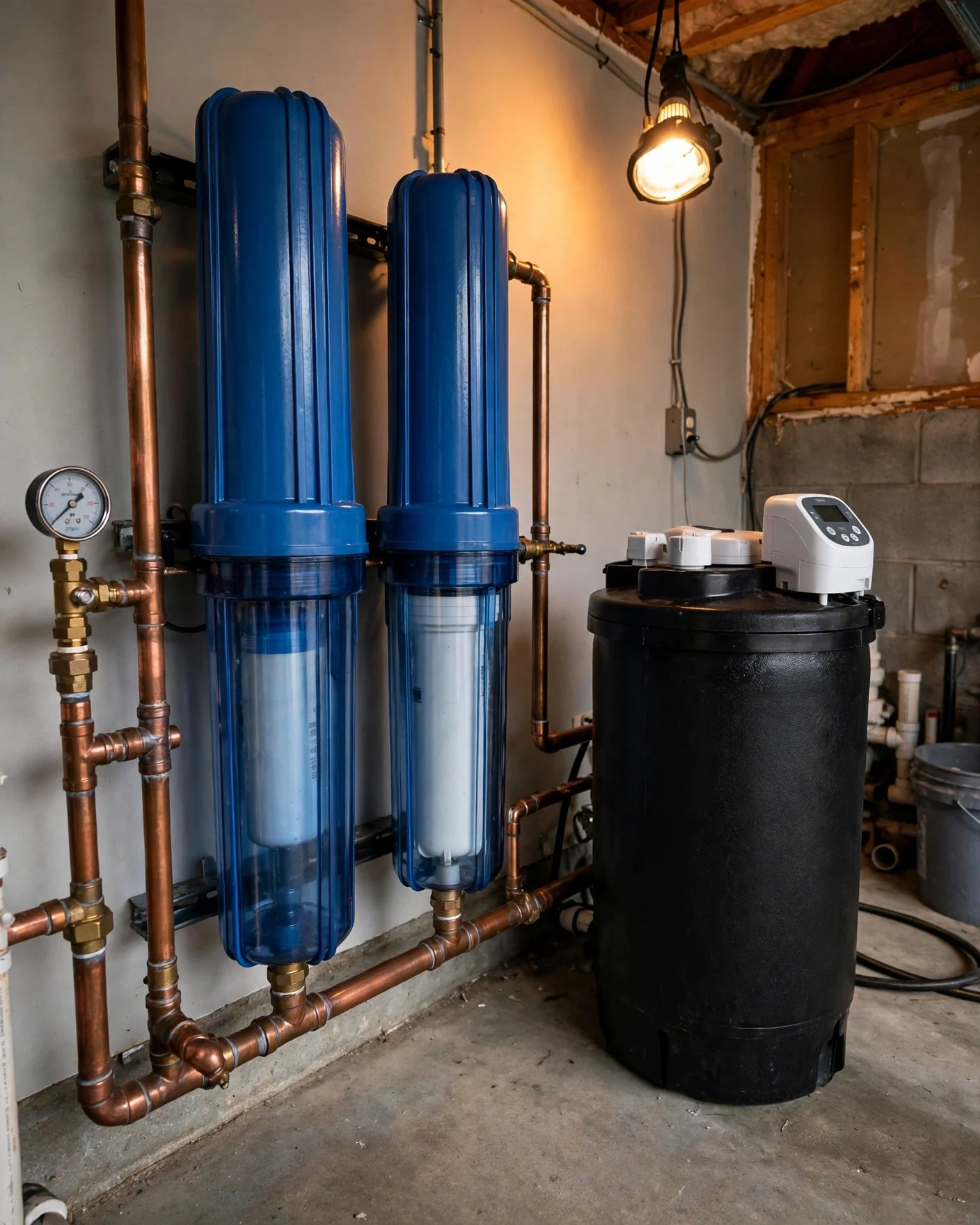
They are not. A whole-house filter cleans your water: it targets chlorine taste and odor, sediment, and — depending on the system — specific contaminants the media is rated for. A water softener does exactly one job: it removes hardness (calcium and magnesium) through ion exchange, and it does nothing for chlorine, taste, or contaminants. Buy the wrong machine and you have spent four figures fixing a problem you never had. We researched and compared the three whole-house filters buyers ask about most — the Aquasana Rhino EQ-1000, the iSpring WGB32B, and the SpringWell CF1 — against what a salt-based softener actually does, covering certifications, five-year cost math, and owner-reported patterns. This guide matches the machine to the problem.
The hardness-only machine
Water softener
~$500–800
Removes hardness (calcium and magnesium) for the whole house; it does not filter chlorine, taste, or contaminants.
The cleaning machine
Whole-house filter
~$230–1,240
Cleans water at the main line — chlorine, taste, odor, sediment, some contaminants; it does not soften water.
The bottom line: these machines answer different questions. A whole-house filter answers “does my water taste, smell, or look bad — or carry something I want reduced?” A water softener answers “is hardness wrecking my fixtures, dishes, and water heater?” A filter will not soften water; a softener will not filter anything. If you have both problems — very common on well water — you need both, filter first: chlorine and sediment shorten a softener’s resin life.
Verdict: chlorine, taste, odor, sediment, or contaminant worries → whole-house filter. Scale, spots, soap that won’t lather → water softener. Both → both, filter first. Test your water before buying either.
Prices are estimates checked at time of writing; they change often — see the live price before you buy.
Table of Contents
Side-by-side comparison

If you are also unsure whether you need whole-house treatment at all, our guide to whole-house vs under-sink filtering covers that fork in the road first.
Here is the whole decision on one screen. The rows that matter most are “what it removes” and “what it does not”: almost every bad purchase in this category comes from buying one machine to do the other’s job.
| Whole-house filter ★ Winner | Water softener | |
|---|---|---|
| Main job | Cleans water at the main line — chlorine, taste, odor, sediment, some contaminants | Removes hardness (calcium and magnesium) for the whole house |
| Mechanism | Carbon / catalytic-carbon / KDF media in tanks or cartridge housings | Ion exchange: resin beads swap hardness ions for sodium or potassium ions |
| Coverage | Every tap, shower, and appliance | Every tap, shower, and appliance |
| Chlorine taste and odor | Yes — carbon media is built for this | No — chlorine passes through the resin untouched |
| Scale and hardness | No — dissolved minerals pass through carbon media | Yes — its entire reason to exist |
| Lead, PFAS, other contaminants | Only if the specific system is rated/listed for them — check the listing | No — ion exchange targets hardness only |
| Purifies water | Partially — targets what its media is rated for, not everything | No — hardness conditioning only, not contaminant filtration |
| Sodium in water | Unchanged | Slightly increased — a result of the exchange |
| Salt or chemicals | None | Salt top-ups every few weeks; brine rinse on a cycle |
| Drain needed | Usually not (tank systems backwash-free by design) | Yes — regeneration flushes to a drain |
| Typical upfront (estimate) | ~$230–1,240 depending on the system | ~$500–800 value unit; $1,000+ with professional install |
| Installation | Confident DIY or plumber — cuts into the main line | Often a plumber — cuts into the main line, needs a drain |
| Best for | Chlorine, taste, odor, sediment, rated contaminant reduction | Hard-water symptoms: scale, spots, dead appliances |
The filter side: three systems, three budgets
These are the three whole-house filters that come up in nearly every “which one” conversation. Our best whole-house water filters roundup ranks the full category; here is how each one fits the filter-vs-softener decision.
Aquasana Rhino EQ-1000 — the long-haul tank system
The Rhino is the premium tank-style filter: Aquasana rates the main tank media for 1,000,000 gallons or up to 10 years (manufacturer-stated), built around a 20-inch sediment pre-filter plus activated/catalytic carbon and KDF copper-zinc media in an upflow design, rated 7 GPM. The brand claims 97% chlorine reduction (brand-stated, not presented as certified). It needs no salt, no backwash, and no drain line — but note the cadence: owner reports put pre/post filter changes at roughly every 2 months, with replacement sets around $60–80 per change (estimate). It is listed to NSF/ANSI 42 (chlorine reduction) and NSF/ANSI 61 (tank/materials) — and not 53 or 401, despite what some retail pages imply (see Certifications). Price sits around $900–1,100 (estimate), with professional install typically $200–600 (estimate). It does not soften water and does not reduce TDS — it is a municipal-water chlorine/taste system, not a well-water or hardness fix.
Pros
- Longest tank-media rating — 1M gallons / up to 10 years per the manufacturer.
- No salt, no drain, no backwash — simpler install than a softener.
- Documented NSF/ANSI 42 + 61 listings — honest, checkable certification.
- 10-year limited tank warranty per the brand’s published terms.
Cons
- Frequent pre/post changes — roughly every 2 months per owner reports; it adds up.
- Does not soften or reduce TDS — hardness problems stay exactly as they were.
- Premium upfront — around $900–1,100 before install (estimate).
- Municipal-water design — not built for iron, sulfur, or well-water chemistry.
Prices are estimates checked at time of writing; they change often — see the live price before you buy.
iSpring WGB32B — the budget 3-stage
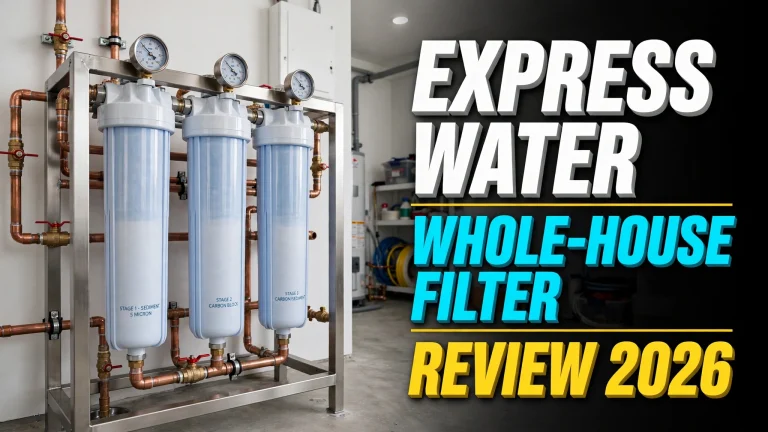
The WGB32B is the value pick: a 3-stage system (5-micron polypropylene sediment + two carbon block stages) in standard 20″×4.5″ housings with 1″ NPT ports, rated 15 GPM with a 100,000-gallon / up-to-12-month capacity (all brand-stated). iSpring’s listing claims “up to 99% chlorine” reduction — a brand-stated bullet, not a certified result. Honesty note: the filters are described as “NSF/ANSI compliant,” which is explicitly not the same as NSF certified; we found no system-level NSF/WQA listing for it. The lead/PFAS language on some listings belongs to the WGB32B-MKS variant, not this base model. Price is around $230–280 (estimate) with replacement sets roughly $200–230 a year (estimate), and a 1-year limited warranty (brand-stated).
Pros
- Lowest upfront cost — around $230–280 (estimate).
- Standard-size cartridges — 20″×4.5″ housings take widely available replacements.
- 15 GPM flow rating — keeps up with household demand (brand-stated).
- Genuine DIY install — owners consistently report a half-day job.
Cons
- “Compliant” is not certified — no system-level NSF/WQA listing we could verify.
- Highest yearly upkeep of the three — roughly $200–230 a year in sets (estimate).
- Variant confusion — lead/PFAS claims belong to the MKS version, not this one.
- Does not soften water — like every filter here, hardness is untouched.
Prices are estimates checked at time of writing; they change often — see the live price before you buy.
SpringWell CF1 — the low-upkeep tank
The CF1 is the set-and-forget tank: upflow carbon + KDF media with a 5-micron sediment post-filter, rated 1,000,000 gallons (~10 years, brand-stated) at 9 GPM on the CF1 size (the line runs to 20 GPM). The media is catalytic coconut-shell carbon plus KDF, and SpringWell’s stated targets include chlorine, chloramine, PFAS/PFOA/PFOS, pesticides, and herbicides — stated by the brand, not third-party performance-certified. We found no system-level NSF/WQA certification listing for it. The selling point is upkeep: the sediment pre-filter swaps every 6–9 months at roughly $27–40 a year (estimate). Price runs about $1,040–1,240 (estimate), with a lifetime warranty on tanks and head and a 6-month money-back guarantee per the brand’s terms. Like the others, it does not soften water, lower TDS, or handle iron, sulfur, or manganese.
Pros
- Cheapest yearly upkeep — roughly $27–40 a year (estimate).
- 1M-gallon tank rating — up to ~10 years before media exhaustion (brand-stated).
- Lifetime tank/head warranty — strongest warranty terms of the three.
- Chloramine on the target list — relevant if your city uses chloramine (brand-stated).
Cons
- No system-level certification — performance claims are brand-stated only.
- Does not soften or reduce TDS — a carbon filter, not a softener.
- Premium price — around $1,040–1,240 before install (estimate).
- Not a well-water system — no iron, sulfur, or manganese handling.
Prices are estimates checked at time of writing; they change often — see the live price before you buy.
The softener side: representative models (comparison only)
A note on how this section works: we are not recommending a specific softener or linking to buy one. These are the representative models you will meet while shopping, described from published specs so the comparison stays honest. Check current prices and certification listings yourself before buying.
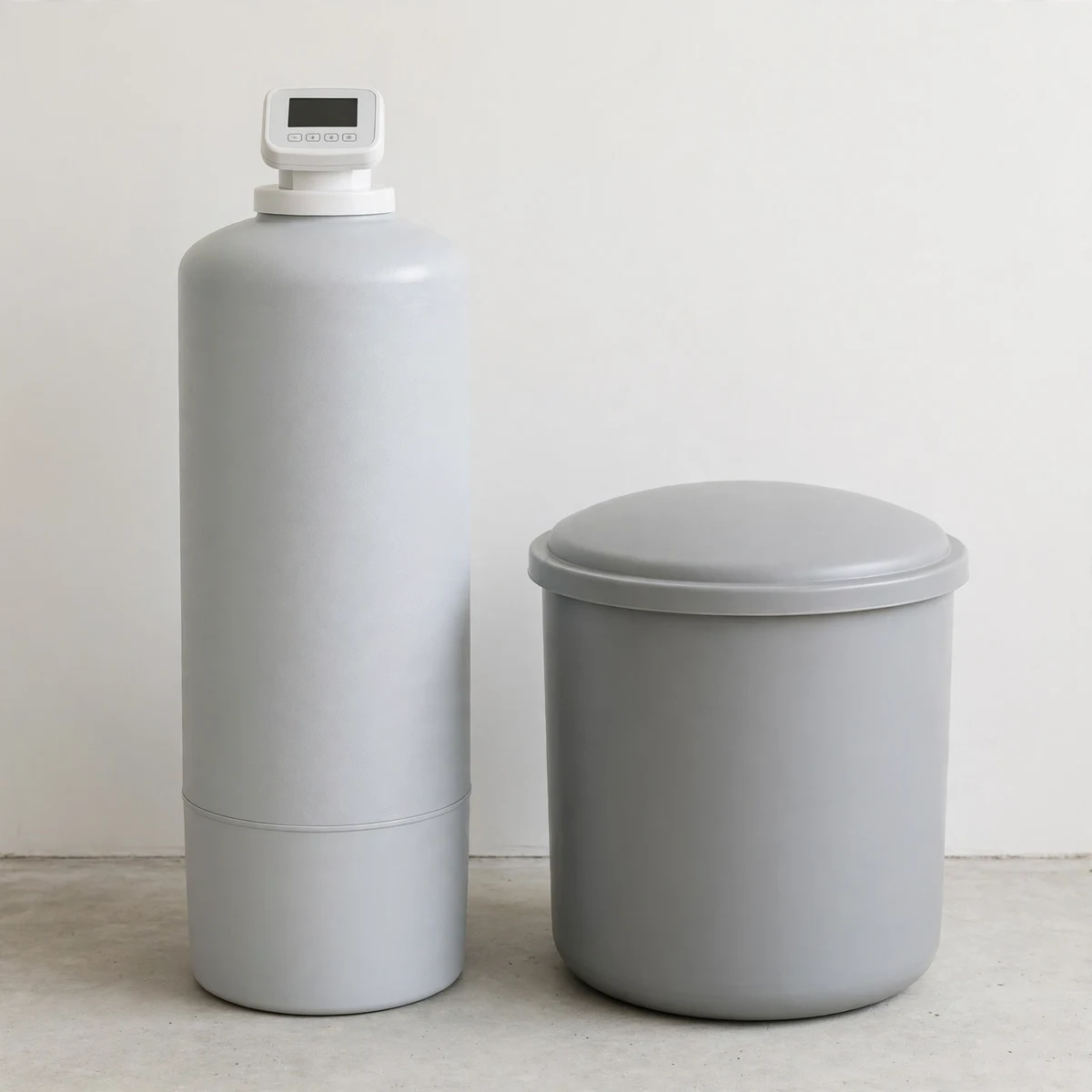
SpringWell SS is the salt-based ion-exchange softener from the same brand as the CF1 filter. Published sizing charts list three sizes — SS1 at 32,000 grains (1–3 bathrooms, ~11 GPM), SS4 at 48,000 grains (4–6 bathrooms, ~13 GPM), and SS+ at 80,000 grains (7+ bathrooms, ~20 GPM) — with metered, demand-initiated regeneration rather than a timer. Fleck 5600SXT-based systems are built around Pentair’s widely used metered control valve: digital LCD, demand-initiated regeneration, Pentair-published valve figures of up to ~20 GPM service flow with 3/4″–1″ ports, typically paired with 24,000–80,000 grain tanks. It is one of the most common residential softener valves, which means parts and technicians are easy to find. Aquasure Harmony is a salt-based line listed in 48,000 and 64,000-grain sizes (the 64K is model AS-HS64D), with a digital metered control head; some configurations bundle a built-in pre-filter.
Pros
- The only fix for hardness — scale, spots, soap scum, and appliance-killing buildup actually end.
- Whole-house coverage — water heater, dishwasher, and laundry included.
- Cheap to run — salt runs a few dollars a bag (estimate); resin lasts many years.
- Protects other equipment — softened feed water extends the life of RO membranes and heaters.
Cons
- Does not filter anything — chlorine, lead, PFAS, and taste are untouched.
- Adds sodium — a consideration on sodium-restricted diets; potassium chloride is an alternative (ask your doctor).
- Salt chore and space — heavy bags, a brine tank to check, and floor space for two tanks.
- Needs a drain — regeneration flushes salt water, so install location matters.
Certifications
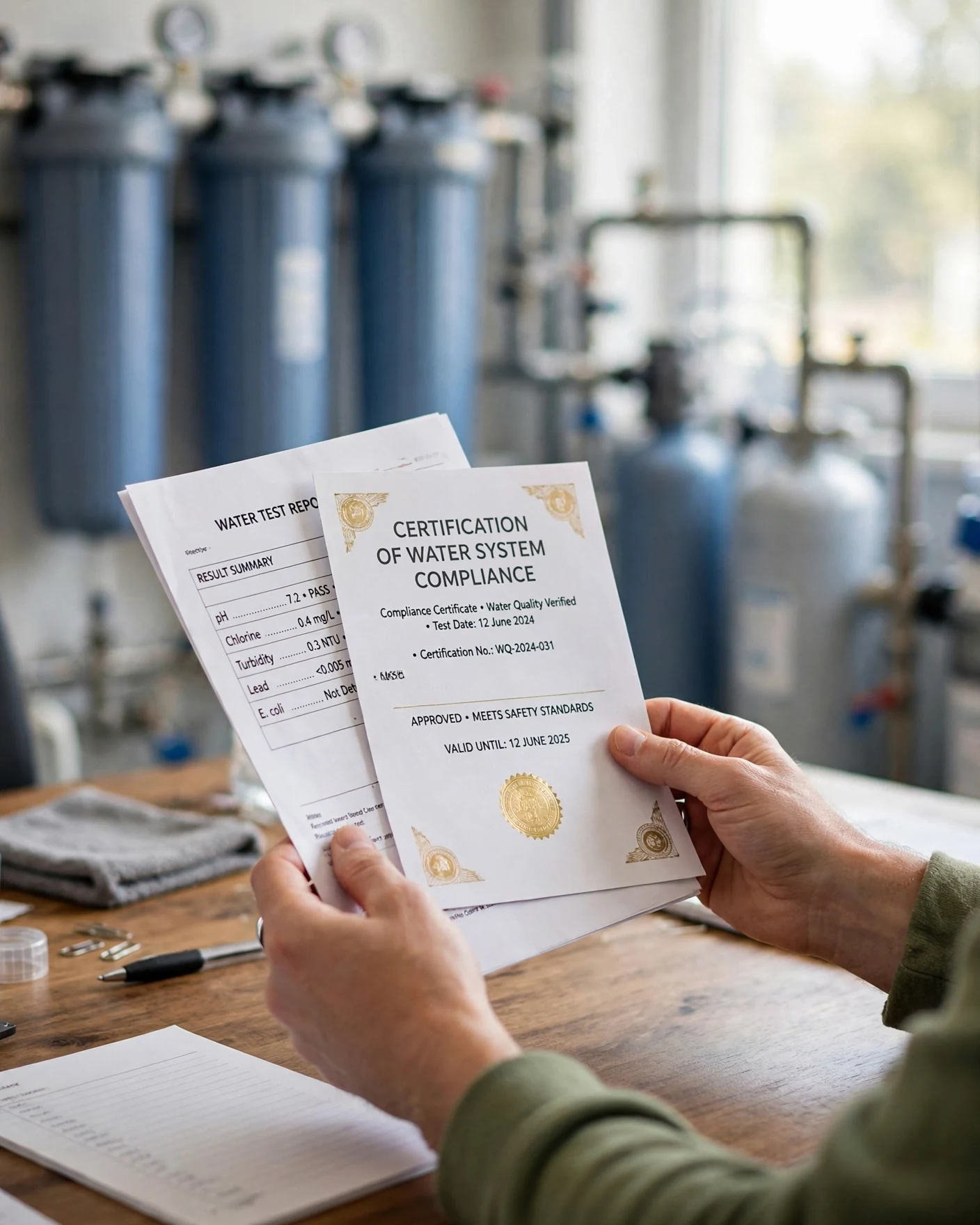
Certification is where filter-vs-softener marketing gets slippery, because each machine is judged against a different standard number — and a seal for one job says nothing about the other. The honest move is to read the exact listed claims in the certifier’s database (info.nsf.org or the WQA directory), not the badge on the box.
| Standard | Applies to | What it certifies |
|---|---|---|
| NSF/ANSI 44 | Water softeners | Residential cation-exchange softener performance — how much hardness is removed and how efficiently the system uses salt. |
| NSF/ANSI 42 | Whole-house filters | Aesthetic effects: chlorine taste and odor reduction. Not a health-contaminant certification. |
| NSF/ANSI 61 | Both (components) | Materials safety — the tank and wetted parts are safe for drinking-water contact. Says nothing about performance. |
| NSF/ANSI 53 | Filters, as add-on claims | Health effects such as lead and cyst reduction — only for the specific contaminants on the listing. |
How the three filters score on honesty: the Rhino EQ-1000 is the cleanest story — Aquasana’s own certification page lists NSF/ANSI 42 and 61 only. Any retail page claiming “NSF 42/53/401” for the Rhino is wrong; that claim is refuted, and we will not repeat it. The SpringWell CF1 has no system-level NSF or WQA listing we could find — its contaminant targets (including chloramine and PFAS) are brand-stated, so buy it for chlorine/taste, not for certified health-contaminant reduction. The iSpring WGB32B is described as having “NSF/ANSI compliant” filters — and compliant is explicitly not certified. On the softener side, look for an NSF/ANSI 44 listing for the exact model at info.nsf.org; we did not database-verify the softener models named above, so treat their certification status as unconfirmed until you check.
Chloramine deserves a special mention: it is harder to remove than chlorine and needs catalytic carbon, not standard carbon. Our chlorine and chloramine guide explains which media actually handles it.
Cost per year
| Rhino EQ-1000 | iSpring WGB32B | SpringWell CF1 | Salt softener (typical) | Both (value combo) | |
|---|---|---|---|---|---|
| System (estimate) | ~$900–1,100 | ~$230–280 | ~$1,040–1,240 | ~$500–800 | ~$730–1,080 |
| Installation | Plumber (~$200–600) | DIY (~$0) | DIY or plumber (~$0–500) | DIY or plumber (~$0–500) | DIY + plumber |
| Yearly upkeep (estimate) | ~$360–480 pre/post sets | ~$200–230 cartridge sets | ~$27–40 pre-filters | ~$60–150 salt + water | ~$260–380 |
| 5-year total (estimate) | ~$2,900–4,100 | ~$1,230–1,430 | ~$1,175–1,940 | ~$800–2,050 | ~$2,030–3,480 |
Three things jump out. First, the cheapest five years belong to the SpringWell CF1 and the iSpring WGB32B, but for opposite reasons: the CF1 costs more upfront and almost nothing to run, while the iSpring costs little upfront and the most per year in cartridges. Second, the Rhino’s headline tank rating hides the real cost — pre/post sets every couple of months make it the priciest filter to own. Third, a value softener is cheap to run (salt is a few dollars a bag, estimate) but the “both” column shows the honest price of solving both problems at once.
The hidden costs are water and attention, not money: a softener flushes salt water to a drain on every regeneration, and the resin bed typically lasts on the order of 10–20 years depending on resin grade and water chemistry (estimate). A filter’s hidden cost is the calendar — skip cartridge changes and flow drops and chlorine breaks through.
Owner voices
We read owner reviews across retail listings and forums to find the patterns that repeat. Here is what keeps coming up on each side.
Filter owners talk about the taste moment — the swimming-pool smell gone from the first glass. Rhino owners praise the tank’s longevity but complain about the pre/post cadence: roughly every two months, and the cost adds up faster than the 10-year tank rating suggests. iSpring WGB32B owners praise the DIY install and the price; the recurring complaints are housing leaks at the fittings and pressure drops when the pre-filter loads up. CF1 owners praise the near-zero upkeep and steady pressure, and the recurring surprise is the “wait, it doesn’t soften anything?” realization — buyers who expected softer-feeling water learn a carbon filter is not a softener.
Softener owners talk about the change they can see: spots gone from the dishwasher, fixtures staying shiny, soap lathering again, the water heater lasting longer. The recurring complaints are about living with the machine: lugging 40-pound salt bags, finding floor space for the resin tank plus brine tank, and the monthly salt-check chore. A smaller but steady thread is the “slippery” feeling of softened water in the shower — some love it, some never get used to it. And the mirror image of the filter surprise: owners who expected cleaner-tasting drinking water learn a softener is a hardness machine only.
The pattern across both: owners who tested their water first and bought the machine that matched the result are happy. Owners who bought a machine and hoped it would fix everything are the ones writing the one-star reviews.
Which should you buy?
Buy the whole-house filter if
- Your water smells or tastes of chlorine, or you want sediment and rated contaminant reduction at every tap.
- Your water is soft enough already — no scale, no spots, soap lathers fine.
- You want no salt, no drain, no programming — the Rhino and CF1 need none of it.
- Budget pick: iSpring WGB32B (~$230–280, estimate). Low-upkeep pick: SpringWell CF1 (~$1,040–1,240, estimate). Long-haul pick: Rhino EQ-1000 (~$900–1,100, estimate).
Buy the water softener if
- You see hard-water symptoms — scale on fixtures, cloudy dishes, soap that won’t lather, crust in the kettle.
- Your water heater or appliances are dying early from scale buildup.
- You own the home, have space for two tanks, and can give it a drain line.
- Your drinking water is already acceptable — only the hardness needs fixing.
Buy both if
- You have both problems — hard water at the fixtures plus chlorine or contaminant worries at the tap.
- You are on well water with hardness plus iron, sediment, or odor — start with our well-water filter roundup for the filter half.
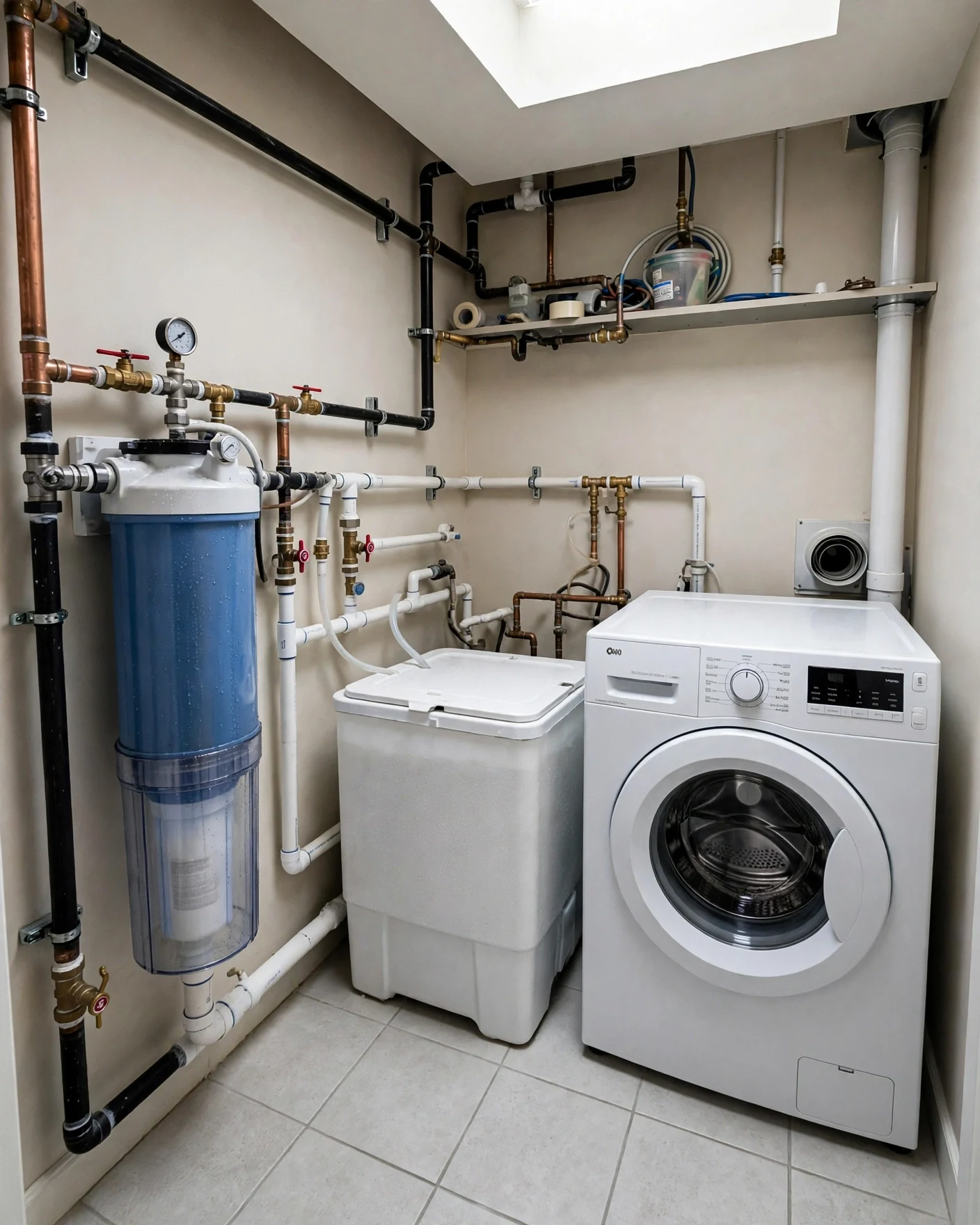
- Install the filter first — chlorine and sediment shorten softener resin life, so the filter protects the softener.
Still weighing a smaller commitment? Our whole-house vs under-sink comparison covers the case for treating one tap instead of the whole house.
FAQs
Will a whole-house filter soften hard water?
No. A whole-house filter uses carbon or similar media that dissolved hardness minerals (calcium and magnesium) pass straight through. It will not stop scale, spots, or soap scum. If hardness is your problem, you need ion-exchange softening — a filter and a softener are different machines.
Does a water softener filter chlorine or make water safer to drink?
No. A salt-based softener targets hardness minerals only — it does not remove chlorine, lead, PFAS, fluoride, or improve taste. It also slightly increases sodium in the water. If chlorine taste or contaminants are your concern, that is a filtration job, not a softening job.
Can I install both a filter and a softener? Which goes first?
Yes — homes with both hard water and chlorine or sediment problems commonly run both. Install the filter first on the main line: chlorine degrades softener resin and sediment fouls it, so the filter protects the softener and the softener then handles the hardness.
How hard does my water need to be before a softener makes sense?
Water-treatment sources commonly use about 7 grains per gallon as the rough threshold where softening starts paying for itself in scale damage and soap waste. Below that, a filter alone is usually the better buy. A $20–30 hardness test (or your utility’s water-quality report) answers this before you spend a dollar.
Is softened water safe to drink?
For most people, yes — softening swaps calcium and magnesium for small amounts of sodium (or potassium, if you use potassium chloride). The EPA maintains a 20 mg/L sodium drinking-water advisory for people on sodium-restricted diets; if that is you, talk with your doctor first or keep an unsoftened or filtered tap for drinking.
Which costs less over five years — a filter or a softener?
It depends on the filter. A value softener runs roughly $800–2,050 over five years (estimate), which beats the Rhino EQ-1000 (~$2,900–4,100, estimate) but loses to the SpringWell CF1 (~$1,175–1,940, estimate) and the iSpring WGB32B (~$1,230–1,430, estimate). The real cost driver is upkeep cadence: salt is cheap, but frequent cartridge changes add up.
Conclusion
A whole-house filter and a water softener are not competitors — they are answers to different questions. Chlorine, taste, odor, sediment, or rated contaminant reduction: buy the filter. Scale, spots, soap that won’t lather, dying appliances: buy the softener. Both problems: buy both, filter first. Test your water, match the machine to the result, and skip everything the test does not justify.
Prices are estimates checked at time of writing; they change often — see the live price before you buy.
Prices are estimates checked at time of writing; they change often — see the live price before you buy.
Update log
- Zulqarnain: Review published.